


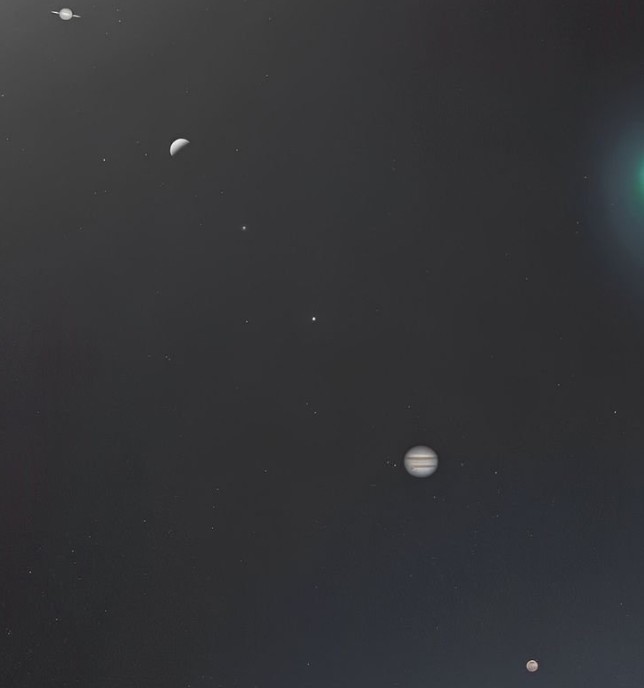
Stargazers across the UK will have the chance to see six planets appear together in the evening sky this weekend, weather permitting.
Mercury, Venus, Saturn, Jupiter, Uranus, and Neptune will line up in what astronomers call a “planetary parade” shortly after sunset.
The best viewing window for the UK is expected on Sunday evening, particularly for those with a clear view of the western horizon.
The event matters because seeing six planets grouped in one part of the sky is unusual and offers a rare opportunity for both amateur and experienced skywatchers to observe multiple worlds in a single night.
What is a planetary parade?
A planetary parade happens when several planets appear to line up from Earth’s perspective. They do not physically form a straight line in space. Instead, they sit along the same flat orbital plane of our solar system.
Dr Becky Smethurst, Research Fellow at the University of Oxford and member of the Royal Astronomical Society, explains: “They will be in a straight line, but it’s a straight line on a curved sky … all the planets orbit in the same flat plane.”
She compares it to spinning pizza dough, which flattens as it rotates, much like the gas cloud that formed the planets around the Sun billions of years ago.
Right now, several planets happen to be positioned on the same side of the solar system from Earth’s viewpoint, creating this visible alignment.
Which six planets can you see from the UK?
Here’s what UK observers can expect:
| Planet | Visible to the naked eye? | Where to Look | Best Viewing Notes |
|---|---|---|---|
| Mercury | Yes (low horizon) | Very low in the western sky | Needs a clear horizon |
| Venus | Yes (very bright) | Low western sky | Often called “Evening Star.” |
| Saturn | Yes (faint) | Western sky | Easier with binoculars |
| Jupiter | Yes (very bright) | Higher in the sky, Gemini | Visible even in cities |
| Uranus | No | In Taurus | Requires telescope/binoculars |
| Neptune | No | Low western sky | Telescope needed |
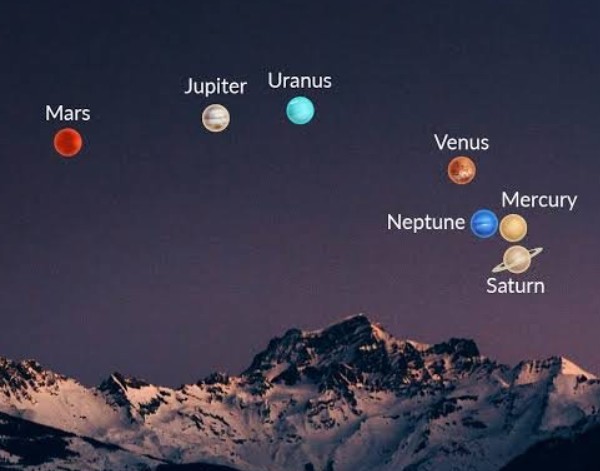
Jupiter will likely be the easiest to spot. It shines brightly and sits higher in the sky in the constellation Gemini. Venus will also stand out clearly, glowing low on the western horizon.
Uranus and Neptune will require binoculars or a telescope. Many local astronomy groups across the UK are hosting viewing sessions this weekend.
When is the best time to see the six planets in the UK?
The planets will appear closest together around 28 February, according to the Star Walk app. However, visibility depends on location.
For the UK, Sunday evening just after sunset offers the strongest chance. London and much of England should see favourable positioning on 1 March, although cloud cover could affect views.
Jess Lee, astronomer at the Royal Observatory Greenwich, said: “A planetary alignment like this can be particularly exciting as it allows you to see various worlds during one evening.”
Where should you look?
- Face west just after sunset
- Choose a location with a clear, unobstructed horizon
- Avoid streetlights and bright areas
- Allow 10–15 minutes for your eyes to adjust to the darkness
Dr. Smethurst recommends waiting indoors in dim light before stepping outside, so your eyes adapt faster.
Will the UK weather allow clear views?
Weather conditions will play a major role.
According to early forecasts:
- Friday night: Clearer skies in Scotland and Northern Ireland
- Saturday night: Better conditions across England and Wales
- Sunday night: Clear spells mainly in eastern and southern England
Cloud cover may limit visibility in some regions, so checking local forecasts on the day remains essential.
How rare is a six-planet alignment?
Seeing six planets together is uncommon but not extremely rare. A full seven-planet parade occurred in February 2025. Astronomers say it will be many years before seven planets become visible together again.
Even if you miss the peak date, there are further opportunities. On 7 and 8 March, Venus and Saturn will appear particularly close in the sky, making them easier to spot.