

Russia is reportedly preparing a strike on power lines supplying Europe’s largest nuclear facility, raising urgent safety concerns across the continent.
What is happening at the Zaporizhzhia Nuclear Power Plant?
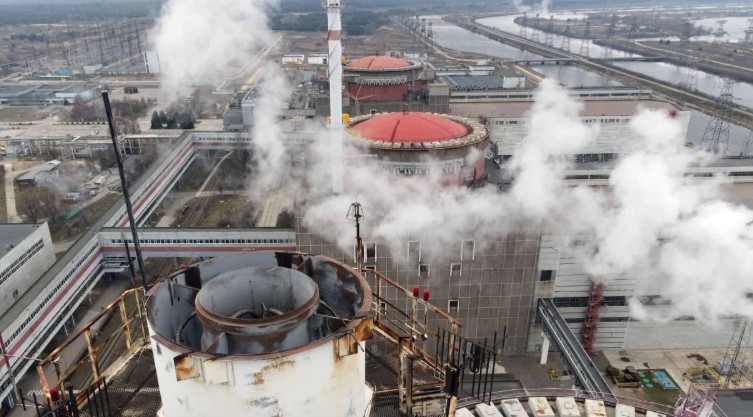
The Zaporizhzhia Nuclear Power Plant (ZNPP) in southern Ukraine, under Russian control since March 2022, is facing a heightened threat.
“The threat is at ZNPP. There are talks of a massive attack either tonight or in the coming nights.”
The plant hosts six VVER-1000 pressurised water reactors. Although currently shut down and not generating electricity, the reactors rely on external power to maintain cooling and safety systems. Any disruption to these systems could have catastrophic consequences.
Ukraine’s Defence Ministry intelligence warned on 17 January that Moscow might target electricity transmission substations critical to nuclear operations.
These attacks are reportedly intended to pressure Kyiv into accepting Russian surrender terms.
How likely is a strike on Europe’s largest nuclear facility?
Intelligence suggests that Russian forces are concentrating on the power lines feeding the ZNPP rather than attacking the reactors directly. However, any damage to external power sources could escalate into a nuclear safety crisis.
A recent localised ceasefire on 16 January, coordinated by the International Atomic Energy Agency (IAEA), allowed repairs to a damaged backup power line at the plant.
This marked the fourth temporary ceasefire brokered by the IAEA during the conflict.
IAEA Director General Rafael Mariano Grossi said: “The IAEA continues to work closely with both sides to ensure nuclear safety at the ZNPP and to prevent a nuclear accident during the conflict.
This temporary ceasefire demonstrates the indispensable role that we continue to play.”
What are the humanitarian implications?
The Ukrainian Parliament and Security Service have warned that Russian forces may escalate attacks on Kyiv’s energy infrastructure if Ukrainian strikes on Russian tankers, oil refineries, and power stations continue.
Winter conditions are worsening the situation. Temperatures have dropped to -20°C, leaving citizens without reliable electricity, heating, or water. The humanitarian risk is compounded by the potential of a nuclear incident.
President Volodymyr Zelensky has called on NATO allies for additional air-defence missiles, highlighting the intensity of Russian attacks:
- Over 1,300 attack drones
- Around 1,050 guided aerial bombs
- 29 missiles of various types in a single week
“That is why Ukraine still needs more protection, above all, more missiles for air defence systems,” he said.
How has Russia targeted energy infrastructure elsewhere?
Russian forces recently struck energy infrastructure in the Odesa region. This continues a pattern of attacks on Ukraine’s power grid, which the IAEA warns could directly compromise nuclear safety across the country.
| Location | Type of Target | Date |
|---|---|---|
| Zaporizhzhia | Transmission power lines | January 2026 (threatened) |
| Odesa region | Energy infrastructure | 14 January 2026 |
| Various Russian assets | Ukrainian counter-strikes | Ongoing |
What could happen if power is cut at ZNPP?
Experts warn that a sustained loss of external electricity could prevent essential cooling systems from operating, risking overheating of reactor cores.
While the reactors are currently offline, the IAEA stresses that nuclear safety relies on a continuous power supply.