
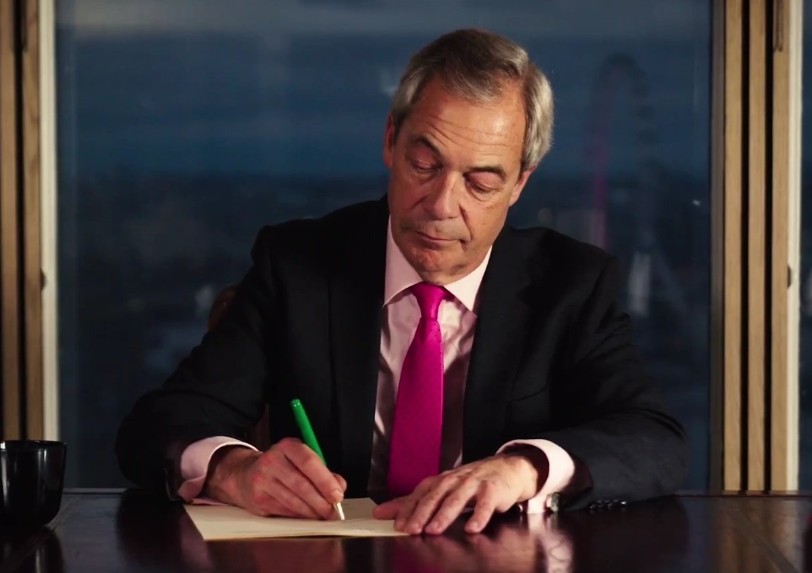
Nigel Farage has demanded sweeping changes to the UK voting system after claiming “cheating” influenced the outcome of the Gorton and Denton by-election.
The Reform UK leader made the remarks on X (formerly Twitter) on Thursday night after the Green Party won the seat in Greater Manchester.
Mr Farage alleged that “family voting” and postal ballot misuse affected the result, and he called for tighter restrictions on postal votes. The comments come as pressure mounts on Labour ahead of the May local elections.
What Happened in the Gorton and Denton By-Election?
The Gorton and Denton by-election saw Hannah Spencer of the Green Party secure victory with a majority of 4,402 votes.
Reform UK’s candidate, political commentator Matt Goodwin, finished second but failed in his attempt to become an MP.
The result means the Green Party now holds five seats in Parliament, a symbolic boost for the party amid growing frustration among some left-leaning voters.
Mr Farage said that despite coming second, Reform UK achieved a strong vote share. However, he immediately questioned how the vote was conducted.
Why Is Nigel Farage Claiming the Vote Was “Illegal”?
In a video posted on X, Mr Farage said: “The Gorton and Denton by-election is a victory for cheating in elections.”
He referred to what he described as “family voting”, where relatives enter polling booths together and allegedly influence each other’s vote.
Under UK electoral law, voters must cast their ballot in secret. The Representation of the People Act 1983 makes it illegal to interfere with or observe someone’s vote inside a polling station.
The Green win last night is already emboldening the radical left.
Just look at the attack on the Churchill statue last night. pic.twitter.com/bRm118CXrM
— Nigel Farage MP (@Nigel_Farage) February 27, 2026
Mr Farage cited figures from an organisation called Democracy of Volunteers, claiming: “In 12 per cent of voting cases they witnessed family voting.”
He also repeated longstanding concerns about postal voting, arguing that ballots are “being abused massively in this country”.
How Does Postal Voting Work in the UK?
Postal voting rules changed significantly in 2001, when the UK introduced “postal votes on demand”. That means any registered voter can request a postal ballot without giving a specific reason.
In 2023, the UK Government introduced new safeguards under the Elections Act, including:
- Limits on how many postal votes one person can hand in at a polling station
- Mandatory voter ID for in-person voting
- Restrictions on campaigners handling postal ballots
According to Electoral Commission data, around 18–20% of votes cast in recent UK general elections were postal votes. In some urban constituencies, the percentage is even higher.
Mr Farage now wants postal voting limited only to elderly, infirm, or overseas voters.
How Have Political Opponents Responded?
Zack Polanski, deputy leader of the Green Party, branded Mr Farage a “sore loser” in response to the allegations. Meanwhile, Labour figures say the result signals a wider political shift rather than electoral wrongdoing.
Angela Rayner described the result as a “wake-up call” for Labour, urging colleagues to “rededicate” themselves to core Labour values.
Unite general secretary Sharon Graham said: “If Labour needed any further wake-up calls, this is clearly one.”
The Fire Brigades Union also warned Labour could face heavy losses in May’s local elections if it does not change direction.
Is Keir Starmer Under Pressure?
Keir Starmer now faces renewed criticism from within his own party. Some Labour groups argue that blocking Greater Manchester Mayor Andy Burnham from standing in Gorton and Denton was a “catastrophic error”.
A Labour-backed group called Mainstream Labour said the party risks losing its status as the “natural home for progressive voters”.
Mr Farage also claimed momentum is shifting toward what he described as “hard-left politics” in Britain.
Is There Evidence of Widespread Electoral Fraud?
The Electoral Commission has repeatedly stated that proven cases of electoral fraud in the UK remain rare.
For example, in 2022, police recorded just a few dozen allegations of fraud across millions of votes cast nationwide. Only a small number led to convictions.
However, critics argue that even isolated cases can damage public trust in elections.