
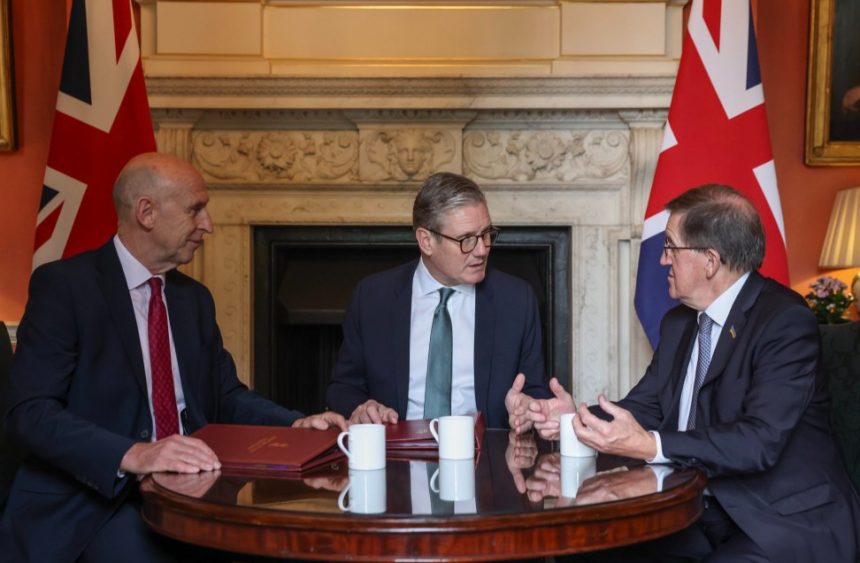
In a damning assessment that has rocked Westminster, Lord George Robertson, the former Nato Secretary General and the man hand-picked by the Prime Minister to lead the Strategic Defence Review (SDR), has issued a chilling warning: the United Kingdom is “underprepared, underinsured, and under attack.”
Breaking his characteristic silence, the Labour peer and former defence secretary used a landmark speech on Tuesday to accuse Sir Keir Starmer’s government of “corrosive complacency.”
He argued that the UK’s national security is currently “in peril” as the Treasury continues to prioritise an “ever-expanding welfare budget” over the urgent modernisation of the British Armed Forces.
With a reported £28 billion black hole looming in the Ministry of Defence (MoD) budget, the intervention marks a pivotal moment in the debate over whether the UK remains a top-tier military power.
Why has a Key Government Adviser Declared UK Security is ‘In Peril’?
The core of Lord Robertson’s intervention lies in the gap between political rhetoric and fiscal reality. While the government frequently speaks of its commitment to NATO and Ukraine, Robertson claims that “non-military experts” in the Treasury are engaging in “vandalism” by stalling necessary investment.
The timing is critical. As the Middle East remains a tinderbox, recent military activity has already highlighted London security gaps that critics argue are the result of years of underfunding.
🚨Former NATO chief has accused Keir Starmer of putting Britain at risk.
George Robertson has accused Keir Starmer of “corrosive complacency” over Britain’s defence.
He claims the UK is being put “in peril” at a time of growing global threats, highlighting a gap between… pic.twitter.com/Po7C1Qilow
— Robert O’Halloran (@robohalloran1) April 14, 2026
Lord Robertson argues that these “bright red signals of danger” are being ignored by the UK’s political leadership. His warning, “We are not safe”, is a direct challenge to the Prime Minister’s decision to delay the publication of the 10-year Defence Investment Plan.
Where Did the Military Funding Go?
A major factor behind the “peril” cited by Lord Robertson is the financial instability within the Ministry of Defence. Analysts have identified a £28 billion shortfall over the next four years, driven by:
- Inflationary Pressures: The rising cost of complex hardware like the Global Combat Air Programme (GCAP) and the Dreadnought-class submarines.
- Legacy Overspends: Unfunded equipment plans inherited from previous administrations that were never fully reconciled with Treasury limits.
- Operational Strain: The cost of maintaining a continuous presence in the Indo-Pacific and the Mediterranean while simultaneously supplying Ukraine with high-end munitions.
Lord Robertson was blunt in his assessment: the UK cannot maintain its global standing while its welfare bill balloons.
“We used to spend one in every seven pounds on welfare,” echoed Tory leader Kemi Badenoch. “Now it’s one in every three. That money has basically been swapped for defence.”
Which UK Regions and Strategic Hubs are Most at Risk?
The warning regarding “underpreparedness” isn’t just about foreign battlefields; it has direct implications for security within the British Isles.
- Cyber Security Hubs (Cheltenham & London): Experts suggest that “grey zone” warfare, cyber-attacks on UK financial institutions and the National Grid, is the most immediate threat. Without investment in advanced signals intelligence, these hubs remain vulnerable.
- Naval Assets (Portsmouth & Plymouth): The Royal Navy is currently struggling with “in-year” savings, which recently delayed the deployment of HMS Dragon to Cyprus during the Iran crisis.
- Energy Infrastructure (The North Sea): Subsea cables and wind farms are increasingly targeted by Russian surveillance vessels. Lord Robertson’s warning implies the UK lacks the sub-surface monitoring capabilities to protect these vital energy links.
- Army Garrisons (Salisbury Plain & Catterick): With the British Army reduced to roughly 70,000 personnel, questions remain about its ability to respond to domestic civil emergencies or major infrastructure sabotages.
What Do Top Officials Say?
The criticism of Starmer’s administration is not limited to Lord Robertson. A chorus of military and political heavyweights has joined the fray:
- General Sir Richard Barrons: Co-author of the SDR, he warned that the military is so “hollowed out” it could only “seize a small market town on a good day.”
- Sir Malcolm Rifkind: The former Defence Secretary called for radical action, suggesting that defence is the “prime responsibility” of the state and should be funded even if it requires cuts to welfare or increases in Income Tax and VAT.
- Sir Ben Wallace: The former Conservative Defence Secretary accused the current Defence Secretary, John Healey, of “taking the public for fools” by claiming the UK is ready for a major conflict.
- Penny Mordaunt: She warned the Treasury that “growth is impossible” if British trade, data, and energy interests aren’t physically protected by the military.
How Does This Defence Crisis Directly Affect the British Public?
The debate in Westminster may feel distant, but the “hollowing out” of the military has tangible effects on UK citizens:
- Taxation Implications: If the government moves toward the NATO-agreed target of 3.5% of GDP by 2035, public spending will have to be diverted from the NHS or education, or taxes must rise.
- Economic Disruption: A lack of maritime security could lead to higher insurance premiums for cargo ships entering UK waters, directly increasing the cost of imported goods and food.
- National Resilience: In a “total war” or major hybrid attack scenario, a smaller military means fewer resources for “Military Aid to the Civil Authorities” (MACA), which the public relied on during the COVID-19 pandemic and major regional flooding.
What are the Next Steps for the Starmer Government?
Sir Keir Starmer has insisted that his administration is “working to finalise” the Defence Investment Plan, but the pressure to act is mounting.
The government has committed to spending 2.5% of GDP on defence by 2027, but critics argue this is too little, too late. The “national conversation” about defence that Lord Robertson demanded is likely to dominate the next parliamentary session.
Expect a series of “tough political decisions” regarding the size of the army and the cancellation of certain multi-billion pound equipment projects to fill the £28bn gap.