Minneapolis has become the centre of a growing political and public storm after immigration agents shot and killed Alex Pretti, a local nurse, during an ICE operation on Saturday.
As protesters march through the city, Minnesota’s governor is openly challenging President Donald Trump, calling for federal agents to be withdrawn amid rising fears of further unrest.
What happened in Minneapolis and why does it matter?
Protests erupted in Minneapolis over the weekend after US immigration agents shot and killed Alex Pretti, a 37-year-old intensive care nurse, during a federal operation on Saturday.
The shooting has triggered public anger, political division, and growing questions about how US immigration enforcement operates in major cities.
The demonstrations come as Minnesota Governor Tim Walz urges US President Donald Trump to remove Immigration and Customs Enforcement (ICE) agents from the city, while the White House demands stronger cooperation from state leaders.
The row matters because it highlights rising tensions between federal authorities, state governments, and the public over immigration enforcement, an issue that continues to divide American voters and influence international perceptions of US policing and civil rights.
Who was Alex Pretti, and what led to his death?
Alex Pretti was a Minneapolis resident and hospital intensive care nurse with no criminal record, according to court documents cited by US media.
His family says he had only received a handful of traffic tickets and had never been involved with law enforcement beyond that.
Federal agents shot Pretti during what Border Patrol described as a “targeted” immigration operation. The Department of Homeland Security (DHS) claims agents fired in self-defence, alleging Pretti was “brandishing” a gun.
Local officials strongly dispute this. Minneapolis Police Chief Brian O’Hara told the BBC: “He was a lawful gun owner. He was not brandishing a weapon, and the firearm had already been removed when he was shot.”
Minnesota law allows people to carry a handgun in public with a valid permit. Eyewitness footage circulating online appears to show Pretti holding a mobile phone, not a weapon, shortly before the shooting.
His family has described the federal account as “reprehensible and disgusting”.
Why are Minneapolis leaders demanding ICE leave the city?
Governor Tim Walz said the US is at an “inflection point”, arguing that federal immigration tactics are fuelling unrest rather than improving public safety.
He has repeatedly called on President Trump to withdraw ICE agents from Minneapolis, especially after two fatal shootings this month involving federal officers.
🚨🔥HOLY SMOKES: This is San Francisco. Minneapolis is the epicenter right now but it’s not the only place protesting.
After Alex Pretti was killed, solidarity protests are spreading nationwide:
Minneapolis
NYC (and NYC nurses)
San Francisco
Los AngelesThis isn’t going away.… pic.twitter.com/6KTZSJzYqT
— Brian Allen (@allenanalysis) January 25, 2026
Earlier in June, another Minneapolis resident, Renee Good, was shot dead while observing an immigration raid, a practice used by activists to monitor enforcement actions.
Local officials say the presence of ICE has disrupted cooperation between law enforcement agencies.
Police Chief O’Hara said: “Federal agents blocked state officers from accessing the scene, despite us having a search warrant.”
Border Patrol commander Greg Bovino rejected those claims and accused city leaders of trying to obstruct federal operations.
What is President Trump’s response?
President Trump has taken a hard public stance, demanding that Minnesota hand over “criminal illegal aliens” held in state prisons for deportation.
In an interview with The Wall Street Journal, published on Sunday, Trump suggested ICE might eventually leave Minneapolis, but offered no timeline.
Trump said, “At some point, we will leave. They’ve done a phenomenal job.”
On social media, the president accused Democratic governors and mayors of “stoking division, chaos, and violence”, and renewed calls for Congress to end so-called sanctuary cities, US jurisdictions that limit cooperation with federal immigration authorities.
How have protests unfolded on the ground?
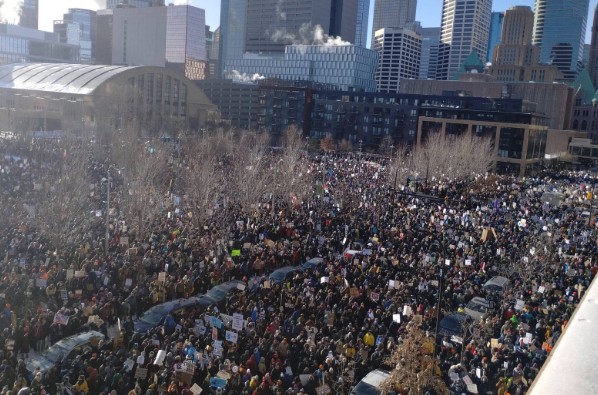
On Sunday evening, hundreds of protesters marched through Minneapolis in freezing temperatures, holding signs reading “Justice for Alex” and “Abolish ICE”.
Federal agents used tear gas and stun grenades to disperse crowds, according to local reporters. Many local workers and business owners also joined wider community actions, echoing demands for accountability.
In fact, Minnesotans shut businesses in a mass ICE-out strike to protest federal enforcement tactics and show solidarity with residents.
Demonstrations have also spread to New York City, Chicago, Los Angeles, and San Francisco, showing the national impact of the Minneapolis shooting.
Are US politicians united on the issue?
No. The shooting has exposed sharp divisions across party lines.
- Louisiana Senator Bill Cassidy (Republican) said the killing was “incredibly disturbing” and warned that the credibility of ICE and DHS is at stake.
- Oklahoma Governor Kevin Stitt (Republican) told CNN that Americans were watching fellow citizens being shot on television and questioned federal accountability.
- Democrats have threatened to block a key government funding bill if it includes money for the Department of Homeland Security, raising the risk of another US government shutdown.
Even the National Rifle Association (NRA) has called for a full investigation, a notable move given its usual alignment with President Trump.
How does public opinion look in the US?
Polling shows a divided picture:
- Around 50% of US voters support deporting people living in the country illegally.
- However, surveys suggest voters are split on how aggressively the policy is being enforced.
- A recent Politico poll found that about half of Americans believe mass deportations have gone too far.
In Minnesota itself, few residents interviewed by the BBC said they supported ICE operations in Minneapolis.
Why is Minneapolis a flashpoint for immigration tensions?
Minneapolis is home to the largest Somali immigrant community in the United States.
Federal immigration operations intensified in December following convictions linked to welfare fraud involving some Somali residents.
State officials argue the crackdown has unfairly targeted communities and escalated tensions without improving safety.