


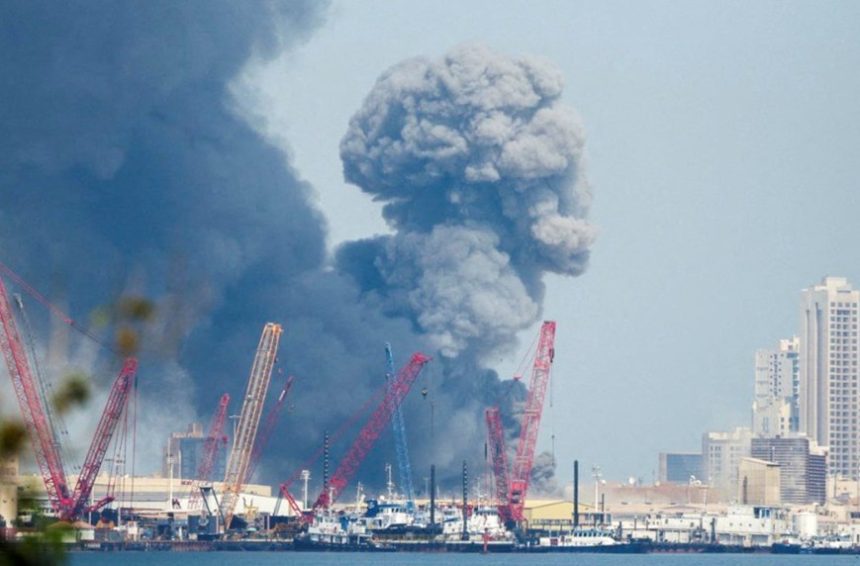
The crisis surrounding Middle East drone warfare intensified this week after Iran launched waves of low-cost drone attacks following the reported killing of its Supreme Leader, Ayatollah Ali Khamenei.
Former UK National Security Adviser Lord Ricketts warned that the United States and Israel are facing an “unsustainable” military equation, with no clear answer to Tehran’s predictable retaliation strategy.
The conflict, now in its fifth day, has expanded beyond direct strikes between Iran and Israel. Gulf oil installations and shipping routes have come under threat, dragging global energy markets and British interests into the crisis.
Prime Minister Keir Starmer is expected to face intense scrutiny in the Commons as questions grow over Britain’s military posture and alliance commitments.
Why is Middle East drone warfare becoming financially and militarily unsustainable?
Lord Ricketts told Sky News that Iran has reverted to what military planners long anticipated: asymmetric warfare.
Unable to match American and Israeli airpower, Tehran is deploying large volumes of relatively cheap drones to overwhelm advanced air defence systems.
He said: “If we’re in a game where $1 million air defence missiles shoot down $1,000 drones, that is not sustainable in the longer-term, either for the Israelis or the Americans.”
The imbalance is stark. A single Western interceptor missile can cost close to £800,000–£1 million. By contrast, many Iranian drones are believed to cost under £1,000 each to manufacture.
Even with high interception success rates, defending against drone swarms becomes financially draining over time.
Security analysts note this strategy does not require Iran to win outright air superiority. Instead, it raises the economic and operational cost of defence while keeping pressure on regional infrastructure.
Lord Ricketts also suggested Iran may be holding back more advanced missile systems, adding another layer of uncertainty.
How has the UK positioned itself amid the escalating conflict?
The UK has taken a cautious but active role. Sir Keir confirmed that British bases, including RAF Fairford in Gloucestershire and the joint UK-US facility at Diego Garcia, may be used by the United States, but only for defensive operations aimed at protecting countries targeted by Tehran.
Meanwhile, the Royal Navy is deploying HMS Dragon, a Type 45 air defence destroyer, to the Mediterranean to strengthen protection around Cyprus following reports that RAF Akrotiri faced drone threats.
US President Donald Trump criticised the Prime Minister, saying he was “not Winston Churchill” after the UK initially declined to authorise US offensive strikes from British soil. Downing Street described the US as a “staunch ally” and declined to escalate tensions publicly.
Lord Ricketts dismissed Mr Trump’s remarks as political rhetoric, stating that British aircraft are already intercepting missiles over the Gulf, a level of engagement not matched by all European partners.
Why does the Strait of Hormuz matter to British households?
Iran’s focus on Gulf oil facilities and the Strait of Hormuz has global implications. Around one-fifth of the world’s oil supply passes through the narrow shipping lane. Any sustained disruption could quickly affect energy prices.
For the UK, that means potential knock-on effects:
- Higher petrol and diesel prices
- Increased household energy bills
- Rising food transport costs
- Pressure on inflation
Energy market shocks in 2022, following Russia’s invasion of Ukraine, showed how rapidly geopolitical instability can filter through to British consumers. Analysts warn that a prolonged Middle East conflict could trigger similar volatility.
Are British nationals in the region facing immediate risk?
The Foreign Office has confirmed that a Government-chartered flight will depart Muscat, Oman, at 7pm for British nationals and their immediate families. Priority will go to vulnerable individuals.
Officials say around 130,000 Britons have registered their presence across the Middle East as tensions rise.
The department is coordinating with airlines to increase evacuation capacity if needed. Citizens have been advised not to travel to airports unless directly contacted by officials.
Is there any realistic path to de-escalation?
Lord Ricketts offered a cautious outlook: “At the moment, it’s still expanding. The curve of the war is still upwards, and I can’t yet see the plateau or the de-escalation towards a ceasefire.”
His warning reflects broader concerns among defence experts. Drone-led warfare allows sustained pressure without immediate large-scale troop deployment. That lowers the threshold for continued escalation while increasing long-term instability.
He also urged the Government to accelerate defence investment, particularly in drone technology and integrated military networks.
Lessons from Ukraine and now the Middle East, he argued, show that future conflicts will rely heavily on unmanned systems and rapid-response air defence.