


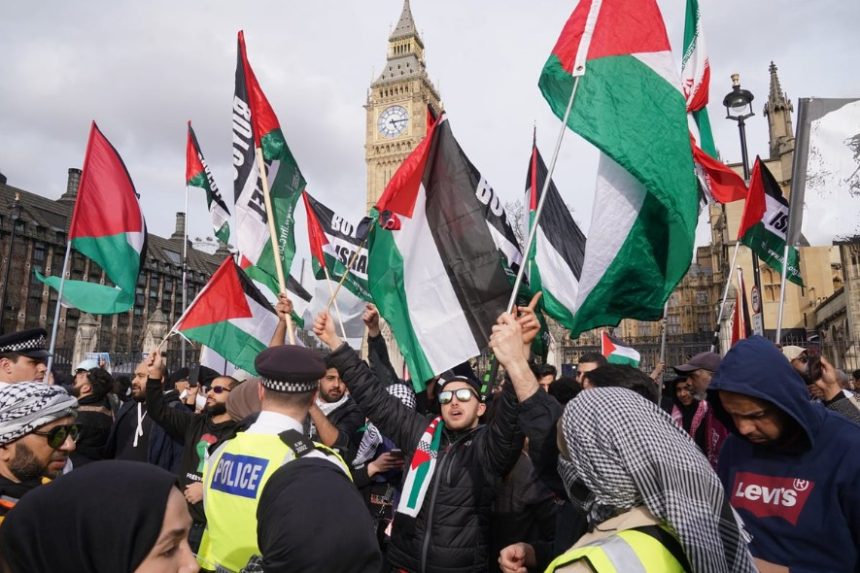
Central London is currently the staging ground for a major security operation as thousands of demonstrators take to the streets today, Saturday, March 21, 2026.
Following the dramatic escalation of the Middle East conflict, sparked by the February 28 US and Israeli strikes on Iran, the capital is hosting two massive, opposing demonstrations.
The Metropolitan Police have enacted rare legal powers to manage the crowds, explicitly banning the use of fireworks and amplified noise after a series of violent outbursts in recent weeks.
With the UK government treading a fine line between supporting allies and avoiding “offensive” war, the atmosphere in the city is one of extreme tension.
What is the Current Situation on London’s Streets?
Today’s unrest is divided into two distinct movements with contrasting goals.
- The “Stop the War in Iran” Coalition: This group, gathering at Russell Square, is protesting against the UK’s perceived complicity in the ongoing war. They cite the recent decision by Prime Minister Keir Starmer to allow the US to use British bases for “defensive” strikes as a dangerous escalation.
- The “Stage for Freedom” Movement: Meeting at Hyde Park Corner, this group consists largely of the Iranian diaspora. They are celebrating the death of the Supreme Leader during the initial strikes and calling for a transition to democracy in Tehran.
The Met Police have confirmed that while the right to protest is protected, they will not hesitate to make arrests if conditions are breached. “We have seen fireworks used as weapons in recent demonstrations,” a spokesperson stated. “This will not be tolerated today.”
Which Areas are Affected by Routes and Road Closures?
The demonstrations are effectively bisecting the West End and Westminster. If you are travelling today, expect significant disruption in these zones:
- Bloomsbury & Russell Square: The primary assembly point for the anti-war march. Congestion is heavy around Holborn and Southampton Row.
- The Procession Route: Protesters are moving through Kingsway, Aldwych, the Strand, and Trafalgar Square.
- Whitehall & Richmond Terrace: This is the final rallying point for speeches opposite Downing Street. Police have ordered all assemblies here to conclude by 6:00 PM.
- Knightsbridge & South Kensington: The “Stage for Freedom” march is moving from Hyde Park toward the Iranian Embassy at Princes Gate. This assembly must end by 5:00 PM.
Travel Warning: Transport for London (TfL) has diverted over 20 bus routes, including the 11, 12, 15, and 159. Nearby Tube stations like Charing Cross and Westminster are operating under “crowd control” measures.
What are the Strict New Police Conditions (Sections 12 & 14)?
The policing of these events has become a focal point of public debate, particularly regarding what constitutes “incitement” in a highly charged political climate.
Officers are currently monitoring the crowds for prohibited slogans, a task that follows recent incidents where the Met Police investigated London demo chants to determine if they breached public order laws.
Superintendent Neil Holyoak, overseeing the operation, has invoked specific powers under the Public Order Act to “minimise disruption to residents and businesses.”
The conditions are as follows:
- Noise Ban: No amplified sound (speakers), musical instruments, or “items struck together” are permitted after 5:30 PM in Whitehall and 5:00 PM at the Iranian Embassy.
- Static Zones: Protesters must remain within “shaded areas” on official police maps until the march begins.
- Proscribed Imagery: Officers are on high alert for symbols related to proscribed terrorist organisations, including the IRGC (Islamic Revolutionary Guard Corps) or Hezbollah.
How has the UK Government Responded to the Unrest?
The protests come at a politically volatile moment. On March 20, the Cabinet met to discuss Iran’s targeting of “Red Ensign” commercial vessels in the Strait of Hormuz.
The government’s official position, as stated by No. 10 Downing Street, is that the UK is not “at war” with Iran.
However, the Prime Minister has confirmed that RAF Typhoons from Cyprus are actively intercepting Iranian drones to protect allies like Jordan and Iraq.
This “defensive-only” stance has been criticized by both the Stop the War Coalition (who call it a legal fiction) and the Conservative Opposition (who argue the UK should be more assertive).
Who is Behind the Demonstrations?
- Stop the War Coalition: Led by figures like Jeremy Corbyn and Zarah Sultana MP, who argue the UK is repeating the “mistakes of Iraq.”
- Iranian Exiles: Groups waving the pre-1979 “Lion and Sun” flag, demanding the UK formally proscribe the IRGC as a terrorist entity.
- Metropolitan Police: Over 1,000 officers have been drafted from across the country to support the London operation.
Is This Related to the Recently Banned Al-Quds Day March?
Yes. Earlier this month, Home Secretary Shabana Mahmood took the unprecedented step of banning the annual Al-Quds Day march (originally scheduled for March 15) for the first time in 14 years.
The Home Office cited “extreme tensions” and a “severe risk of public disorder.” Today’s protests are seen by many as a continuation of that energy, though they are operating under much stricter geographical and noise-based constraints to prevent the “static” assemblies from turning into running battles.
What Happens Next: Further Escalation or De-escalation?
The Met Police will maintain a “high-visibility” presence throughout the evening. Legal experts suggest that if today’s protests result in significant violence, the Home Secretary may consider broader bans on all Middle East-related demonstrations in the capital for 30 days.
Internationally, the UK is bracing for potential retaliatory cyber-attacks from Iranian-linked groups, while the Foreign Office continues to advise all British nationals to leave the region immediately.