


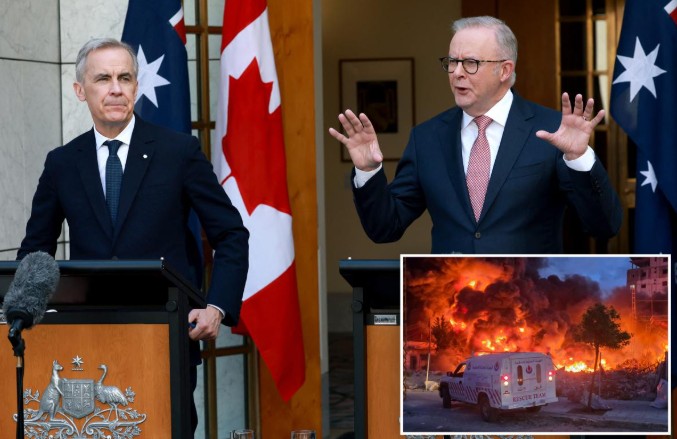
The Iran conflict escalation has prompted fresh international concern after the leaders of Canada and Australia urged calm while stressing that Iran must never be allowed to develop nuclear weapons.
Canadian Prime Minister Mark Carney and Australian Prime Minister Anthony Albanese made the comments on Thursday (5 March 2026) during talks in Canberra.
The meeting took place as tensions rose sharply following reports that a US submarine sank an Iranian warship in the Indian Ocean and that NATO defences intercepted a ballistic missile launched from Iran before it reached Turkish airspace.
Both leaders called for a wider international effort to reduce hostilities while ensuring Iran cannot develop nuclear arms.
Why are global leaders warning about Iran conflict escalation now?
Recent military incidents have intensified fears that the conflict could spread across the Middle East and beyond.
According to reports emerging this week:
- A US submarine sank an Iranian warship in the Indian Ocean during a confrontation linked to the ongoing regional conflict.
- NATO defence systems reportedly intercepted an Iranian ballistic missile before it entered Turkish airspace.
- Several Gulf states have reported attacks affecting civilian and tourist areas, increasing regional anxiety.
These developments have raised the risk of a broader international confrontation if the situation continues to deteriorate.
What did Mark Carney say about the Iran conflict escalation?
Speaking at a press conference in Canberra, Carney called for a coordinated international effort to bring tensions down.
“We want to see a broader de-escalation of these hostilities with a broader group of countries than just the direct belligerents involved,” Carney said.
Canadian PM Mark Carney on Iran:
One can never categorically rule out participation… We will stand by our allies if it makes sense.
We will always defend Canadians and we will always defend our allies when called upon.#Iran #Israel #US #Trump pic.twitter.com/U4N2vbARGC
— The Dominican post. 🇩🇴🇺🇸 (@rovinsonfranzua) March 5, 2026
However, he made clear that diplomacy must also address long-standing concerns over Iran’s nuclear ambitions.
“That cannot be achieved unless we’re in a position where Iran’s ability to acquire a nuclear weapon, develop a nuclear weapon, and export terrorism is ended,” he added.
Carney also suggested that the six-member Gulf Cooperation Council should play a role in calming tensions.
The Gulf Cooperation Council includes:
| Member State | Capital |
|---|---|
| Saudi Arabia | Riyadh |
| United Arab Emirates | Abu Dhabi |
| Qatar | Doha |
| Kuwait | Kuwait City |
| Bahrain | Manama |
| Oman | Muscat |
Carney said these countries had been “showing tremendous restraint” despite the growing instability in the region.
How did Australia respond to the growing crisis?
Australian Prime Minister Anthony Albanese echoed the call for calm but warned that Iran’s actions were destabilising neighbouring countries.
“The world wants to see a de-escalation and wants to see Iran cease to spread the destinations of its attacks,” Albanese said.
He highlighted the impact of attacks on countries not directly involved in the conflict. “We’re seeing Gulf states that have not been involved, attacked across the board, including attacks on civilian and tourist areas.”
Albanese also reiterated the long-standing international goal of preventing Iran from developing nuclear weapons. “I want to see the possibility of Iran getting a nuclear weapon removed once and for all.”
Could Canada become militarily involved?
During the press conference, journalists asked Carney whether Canada might eventually join military operations if the conflict widened.
He did not rule out that possibility. “You’ve asked a fundamental hypothetical in a conflict that can spread very broadly. One can never categorically rule out participation. We will stand by our allies when it makes sense,” Carney said.
Canada is a member of NATO and has historically supported allied operations in conflicts where collective security is involved.
Why does the Iran conflict escalation matter to the UK?
Although Britain is not directly involved in the current clashes, the situation could affect the UK in several ways.
Potential UK impacts include:
- Energy prices: Any disruption in Gulf shipping routes could push up global oil prices, affecting petrol and heating costs in the UK.
- Security cooperation: Britain works closely with NATO allies involved in monitoring the region.
- Diplomatic pressure: The UK government often participates in international negotiations aimed at limiting nuclear weapons programmes.
The UK also played a major role in the original Iran nuclear agreement negotiations in 2015, alongside the US, France, Germany, Russia and China.
What was Mark Carney doing in Australia?
Carney’s comments came during a three-nation diplomatic and trade tour.
His trip includes:
- India, where he held economic talks earlier this week.
- Australia, where he addressed the Australian Parliament on Thursday.
- Japan, where he is scheduled to travel on Friday.
While trade and economic cooperation remain the main focus, the worsening Middle East crisis dominated discussions during the Canberra meeting.