


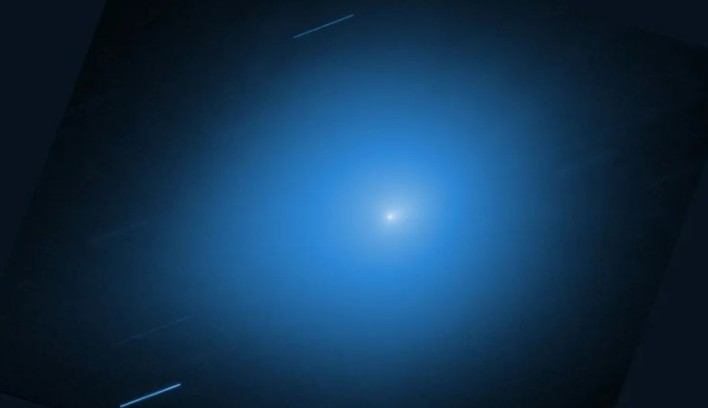
A rare visitor from beyond our Solar System will glide past Earth overnight, giving scientists and curious skywatchers a fleeting opportunity to observe material formed around another star.
Interstellar comet 3I/ATLAS, only the third object of its kind ever confirmed, reaches its closest point to Earth in the early hours of Friday morning.
While it will not deliver dramatic naked-eye views, its importance lies in science rather than spectacle.
What exactly is interstellar comet 3I/ATLAS?
Interstellar comet 3I/ATLAS is a space object that did not originate around our Sun. Instead, it was formed in a completely different star system before being ejected into interstellar space and eventually passing through ours.
Its discovery in July 2025 by the ATLAS survey placed it in a very exclusive category. Until now, astronomers have only confirmed two similar visitors: ‘Oumuamua in 2017 and Borisov in 2019.
Each has reshaped scientific understanding of how common such objects may be in the Milky Way.
That has allowed scientists to capture unprecedented detail, including fresh Hubble observations showing active outgassing, which reveal that the comet is releasing gas and dust as it warms.
Unlike asteroids or comets born within the Solar System, interstellar objects travel at extreme speeds and follow unusual paths, making them hard to detect and even harder to study.
When will 3I/ATLAS be closest to Earth?
The comet reaches its closest approach at around 6:00am GMT on Friday, 19 December, passing Earth at a distance of roughly 168 million miles (270 million kilometres).
We’re continuing to observe the interstellar comet 3I/ATLAS as it heads out of our solar system.
Have questions about the comet? Join us Friday, Dec. 19 for a 3I/ATLAS @Reddit AMA with NASA experts: https://t.co/yzlYmjbQki pic.twitter.com/TbBPj1cWeN
— NASA (@NASA) December 18, 2025
That distance may sound vast, and it is, but in astronomical terms, it represents a relatively close encounter. Scientists have stressed there is absolutely no danger to Earth, as the comet remains nearly twice as far away as the Sun.
At the time of closest approach, 3I/ATLAS will already be moving away from the Sun and preparing to exit the Solar System for good.
Can people in the UK see it?
For most members of the public, the answer is “not easily”.
3I/ATLAS is expected to shine at about magnitude 11, which is far too faint to be seen with the naked eye. Even under dark rural skies, it will appear unimpressive unless viewed through specialised equipment.
Astronomy experts say experienced observers using medium to large telescopes stand the best chance of spotting it as a small, fuzzy patch of light.
It sits in the constellation Leo, close to the bright star Regulus, but locating it without automated tracking systems can be challenging.
According to astronomers from Sky at Night, the comet may show a subtle greenish hue, though it will lack the dramatic tail many people associate with comets.
Why are scientists so interested in 3I/ATLAS?
The real value of interstellar comet 3I/ATLAS lies in what it can reveal about the wider galaxy.
Because it formed around another star, its chemical makeup offers clues about how planets and comets develop beyond our own Solar System. Studying it allows scientists to compare those distant processes with what we observe closer to home.
NASA and other space agencies are closely monitoring the comet. Recently released ultraviolet images from NASA’s Europa Clipper spacecraft, taken from about 102 million miles (164 million kilometres) away, have already provided valuable data.
Further observations are expected following its closest approach, helping researchers refine models of interstellar travel and object formation.
At the same time, researchers have announced new breakthroughs in understanding its internal activity, based on combined data from Earth-based observatories and space missions.
These findings are helping scientists refine models of how interstellar objects evolve as they pass close to a star for the first time.
As one NASA scientist explained in a recent briefing, “Each interstellar object gives us a rare sample of another planetary system without ever having to leave our own.”
How does 3I/ATLAS compare with previous interstellar visitors?
While Borisov in 2019 offered clearer visual features, including a visible tail, 3I/ATLAS arrives at a time when detection technology and data-sharing have significantly improved.
That means scientists can study it in greater detail, even if it appears less impressive through a telescope.
‘Oumuamua, by contrast, was detected late and left many unanswered questions, questions that researchers are now better equipped to tackle.
Interstellar comet 3I/ATLAS is only the third confirmed object from beyond our Solar System to pass through it.
It reaches its closest point to Earth at around 6:00am GMT on 19 December, remaining a safe but scientifically valuable distance away.
While difficult to observe visually, it is being closely studied by NASA and international observatories.
For the public, online streams and expert coverage offer the best way to witness this rare cosmic encounter.
What does this mean for the UK public?
Events like this highlight how frequently our Solar System interacts with the wider galaxy, often without us noticing.
Although most people will not see 3I/ATLAS through a telescope, its passage is a reminder that space is dynamic, busy, and far more connected than it once seemed.
Each discovery brings scientists a step closer to understanding how common planetary systems like our own really are.