
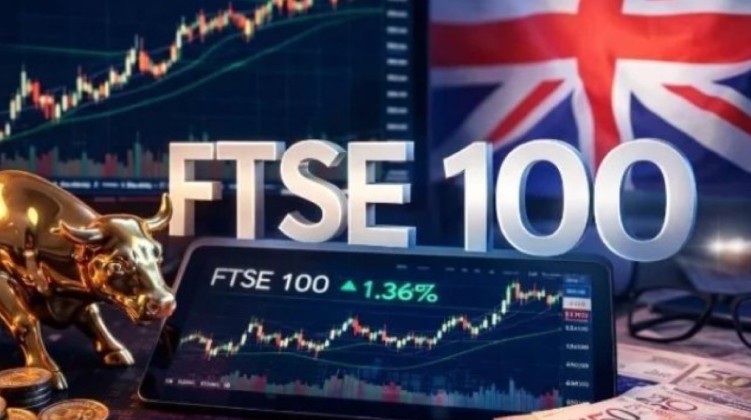
The FTSE 100 is set to break fresh ground on 12 February after Schroders confirmed it has backed a £9.9 billion takeover offer from US investment group Nuveen.
The move has lifted confidence across the City and helped push London’s main index towards a new milestone of 10,500 points.
The rally comes as new data from the Office for National Statistics (ONS) shows the UK economy barely expanded in December and the final quarter of 2025, raising questions over whether the UK can maintain stronger momentum into 2026.
Why is the FTSE 100 expected to open above 10,500 today?
London’s leading index continues to benefit from strong corporate headlines and renewed investor interest in UK blue-chip stocks.
On Tuesday, the FTSE 100 surged 1.1%, closing at a record 10,472.11, its best daily performance in over a year. The index also touched an intraday high of 10,493.83.
According to IG Futures, the FTSE 100 is forecast to rise again by around 0.3%, placing it firmly on track to open above 10,500 for the first time.
Market watchers say the momentum reflects a mix of takeover activity, bargain-hunting in UK shares, and investors rotating away from US markets, which remain uncertain due to interest rate expectations.
Key numbers driving the market today include:
- FTSE 100 close (Tuesday): 10,472.11
- Daily rise: +118.27 points
- Intraday peak: 10,493.83
- Forecast opening move: +0.3% (around 35.9 points)
What does the Schroders £9.9bn takeover mean for the FTSE 100?
The biggest headline influencing the FTSE 100 today is Schroders’ announcement that its board has backed a £9.9 billion takeover offer from Nuveen, an American investment firm.
If approved, the deal would create one of the world’s largest active asset management businesses, overseeing around £1.8 trillion in assets under management.
Importantly for the UK financial sector, the companies said the Schroders brand will remain, while London will serve as the group’s main non-US headquarters and largest office.
The offer values Schroders’ shares at 612p, which includes dividends worth 22p. The cash part of the deal stands at 590p, representing a 29% premium to the previous day’s closing price and 42% above the three-month average.
Schroders Chief Executive Richard Oldfield welcomed the deal, pointing to the growing pressure on fund managers to expand scale and compete globally.
“In a competitive landscape where scale can help deliver benefits, in Nuveen, we see a partner that shares our values, respects the culture we have built, and will create exciting opportunities for our clients and people,” said Richard Oldfield.
For the FTSE 100, this matters because Schroders is a major financial stock and a takeover of this size adds weight to the narrative that UK-listed firms remain undervalued compared with overseas peers.
How strong is the UK economy right now, according to the ONS?
Alongside the market rally, investors are digesting new figures showing that UK growth remains fragile.
The ONS reported GDP growth of just 0.1% in December 2025, while the wider economy also grew only 0.1% across the fourth quarter of 2025.
Despite the weak finish to the year, the data suggests annual GDP growth in 2025 reached 1.3%, slightly above the 1.1% recorded in 2024.
Liz McKeown, the ONS Director of Economic Statistics, said the services sector, usually the backbone of the UK economy, showed no growth in the final quarter. Instead, manufacturing provided the key support.
Construction, however, delivered its worst performance in more than four years, highlighting continued strain in housebuilding and infrastructure activity.
“The rate of growth across 2025 as a whole was up slightly on the previous year, with growth seen in all main sectors,” said Liz McKeown.
She also added that early estimates suggest GDP per person rose compared with the previous year, although it dipped slightly in each of the last two quarters.
Why did the FTSE 250 fall while the FTSE 100 rose?
While the FTSE 100 surged, the FTSE 250, which includes more UK domestic-focused companies, moved in the opposite direction. It fell 0.2% to 23,416.54.
Analysts often view this split as a sign that investors still trust large international UK firms more than mid-sized businesses tied closely to the domestic economy.
Many FTSE 100 firms earn revenue overseas, so they can perform well even when the UK economy looks sluggish.
This gap between the two indices reinforces concerns that everyday UK economic conditions remain weaker than the headline FTSE 100 rally suggests.
What are global markets doing, and why does it matter for the FTSE 100?
Overnight, US markets produced a mixed session after strong nonfarm payroll figures reduced expectations that the US Federal Reserve will cut interest rates quickly.
The results were cautious but not dramatic. The Dow Jones slipped slightly, tech stocks softened, and the S&P 500 ended flat.
That global uncertainty matters because the FTSE 100 often reacts to shifts in US interest rate expectations, particularly through banking, energy, and mining shares.
Overnight US market moves were:
- Dow Jones: -0.1%
- Nasdaq Composite: -0.2%
- S&P 500: flat
Meanwhile, gold edged lower to around $5,068 an ounce, while sterling stood near $1.3624 ahead of the GDP release.
What does this mean for UK investors today?
For investors, the FTSE 100 reaching above 10,500 represents a strong confidence signal, but not necessarily a guarantee of long-term stability.
The Schroders takeover story adds momentum, but the wider economic picture remains mixed. UK growth remains slow, construction looks weak, and the lack of services expansion raises concerns about whether the UK economy can accelerate without further support.
However, takeover activity of this scale may encourage investors to believe more UK firms could attract bids, particularly if overseas buyers see value in London-listed companies.