


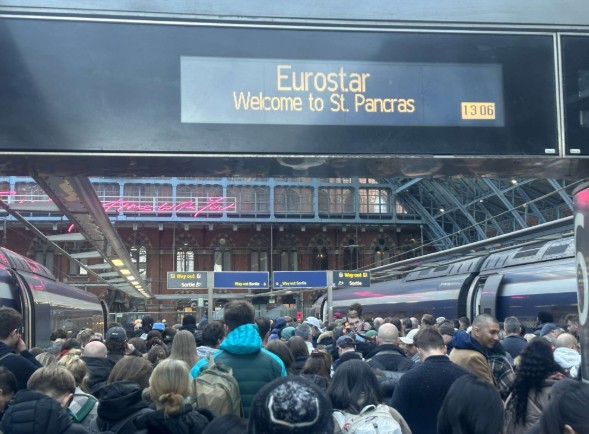
Eurostar passengers travelling from the UK to mainland Europe were left angry and exhausted on New Year’s Eve after Eurostar train services to Paris and Amsterdam became stranded for hours overnight in Kent, with some travellers reporting power failures, unusable toilets and a complete lack of information.
The disruption unfolded late on Tuesday night and stretched into the early hours of New Year’s Eve, affecting passengers who had boarded trains at London St Pancras before 9pm.
By 3am, at least two Eurostar trains remained stuck on the tracks, unable to continue or return quickly.
The incident comes at a time when Eurostar has been reassuring passengers over wider operational changes, including recent updates on new EU border checks, which the operator has said should not cause major queues for UK travellers.
What caused the Eurostar train disruption?
Eurostar confirmed the chaos was triggered by an overhead power supply failure in the Channel Tunnel, made worse by a broken-down LeShuttle train blocking part of the route.
In a late-night update, the company said: “As the overhead power supply issues in the Channel Tunnel still remain, only one line is available to run trains on.”
With capacity severely reduced, Eurostar was forced to cancel all London-to-Europe services, leaving trains already en route stranded for hours with limited options.
How long were passengers stuck on board?
Many passengers said they were trapped on board for five to seven hours, spending most of the night inside stationary trains.
Youssef, a passenger travelling from London to Paris, said he had already been stuck for five hours shortly after midnight.
Nearly four hours later, he reported that passengers were still waiting for updates and had been told there was only a “50/50 chance” of reaching Paris rather than being sent back to London.
“No electricity, no toilet, no information. Crew are dealing with angry passengers and haven’t slept themselves,” he wrote on social media.
Were basic facilities really unavailable on the trains?
Several passengers confirmed that onboard power failures led to toilets stopping working, dim or non-existent lighting in some carriages, and a lack of charging points for phones.
With communication systems affected, passengers said they received little to no official information for hours at a time. As frustration grew, Youssef joked online: “It’s electricity… just plug the cables together.”
Another traveller, Gérard Manvuca, criticised Eurostar’s overnight response, saying that at 4am there was still no clear guidance online.
“Nothing on the company’s website. A disgrace,” he wrote.
What happened to the London–Amsterdam Eurostar train?
Passengers travelling on the London–Amsterdam route described a particularly demoralising experience.
Ryan, one passenger on board, said the train briefly moved backwards before stopping again at around 3.20am. “It feels like we’ll see the last sunrise of the year from the train,” he said.
Later, rail experts and enthusiasts online suggested there was little chance of reaching continental Europe, after a diesel locomotive arrived to tow stranded Eurostar trains back to London St Pancras.
The disruption contrasts with Eurostar’s longer-term fleet plans, which recently included the return of double-decker trains aimed at increasing capacity on busy routes.
How did the disruption affect St Pancras and the Eurotunnel?
At St Pancras International, passengers whose trains had been cancelled gathered behind cordons as staff attempted to manage the situation. Eurostar employees were seen handing out water bottles and advising travellers to rebook for another day.
The knock-on effects were also felt at the Eurotunnel terminals, where traffic built up on approach roads to Folkestone. In Calais, LeShuttle passengers faced long waits inside stationary trains.
Tim Brown, returning to the UK after Christmas in Germany, said he had been stuck for more than three hours with no access to food or water.
“I’m travelling with my dogs, and they’re hating life,” he said.
What has Eurostar said in response?
Eurostar issued an apology, stressing that the disruption was outside its direct control. “We continue to advise our customers to rebook their journey for another day if possible, with free exchanges available,” the company said.
Passengers were also warned not to travel to stations if their trains had already been cancelled, as delays were expected to continue.