


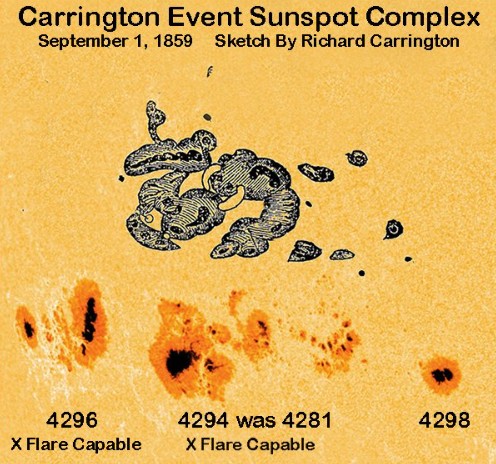
A massive sunspot cluster, labelled AR 4294- 4296, has rotated into view on the Earth-facing side of the Sun, sparking interest among space scientists and suckers likewise.
The active region is currently drawing compared to the Carrington Event of 1859, the most important geomagnetic storm ever recorded.
AR 4294-4296: A Rare Sunspot Group
The sunspot cluster was first detected on the far side of the Sun by satellites but became completely visible on 28 November.
Its enormous size and complex, glamorous structure make it a high seeker for producing solar flares and coronal mass ejections (CMEs).
Experts advise that while not every large sunspot causes a major storm, the current region is being monitored precisely for any signs of increased activity.
AR 4294- 4296 represents one of the most energetic solar regions observed in recent times, and its implicit goods on Earth can not be ignored.
Why the Comparison to the Carrington Event Matters?
The major Carrington Event disintegrated telegraph systems worldwide and produced auroras visible far near to the ambit than usual.
AR 4294- 4296 is being studied because a similar event moment could have serious consequences for ultramodern technology, including:
- Satellite dispatches and GPS systems
- Electrical grids and power structures
- Radio and internet dispatches
While the public shouldn’t be frightened, the comparison highlights the significance of space rainfall monitoring and preparedness.
Possible Effects on Earth
Still, dangerous radiation could temporarily reach Earth if AR 4294- 4296 produces strong solar flares. Meanwhile, coronal mass ejections may disturb the Earth’s magnetic field, potentially driving daybreaks indeed at low altitudes.
Scientists emphasise that timing and intensity vary depending on the sunspot’s glamorous development and the direction of ejected solar material.
Spectators may be able to see spectacular daybreaks if exertion intensifies, particularly in areas unaccustomed to similar displays.
Monitoring and Precautionary Measures
Solar lookouts and satellites are tracking AR 4294- 429624/7. Space rainfall centres are ready to issue cautions if the sunspot produces dangerous flares or CMEs.
Scientists are analysing the cluster’s glamorous patterns to read implicit eruptions and minimise pitfalls to satellites, aeronautics, and power systems.
For the public, experts stress staying informed through sanctioned channels and being apprehensive of the possible impact, rather than sacrificing.