


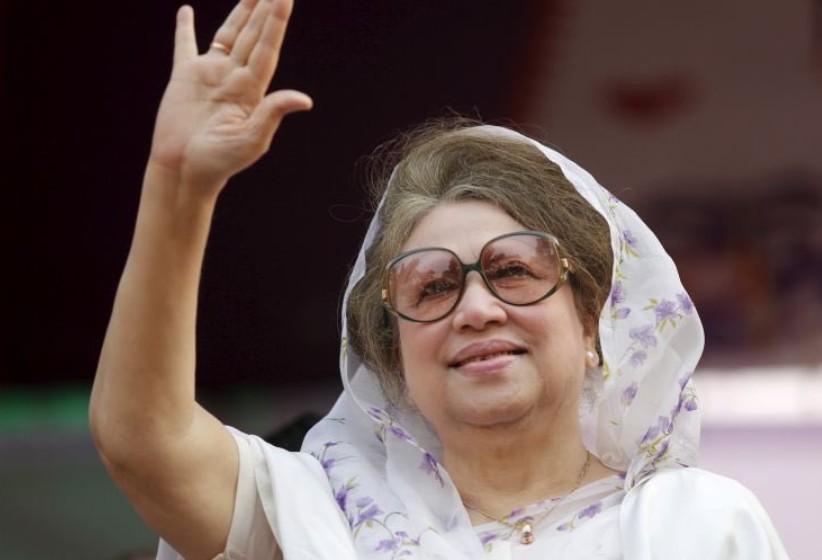
The death of BNP Khaleda Zia, Bangladesh’s first woman prime minister, has brought an end to one of South Asia’s most extraordinary political eras.
Khaleda Zia died in Dhaka on Tuesday, aged 80, following a long battle with multiple serious illnesses, according to her doctors.
Her passing comes at a turning point for Bangladesh, where both she and her lifelong rival, Sheikh Hasina, are now absent from power, closing a rare chapter of women-led politics that shaped the country for more than three decades.
Who was BNP Khaleda Zia, and why did she matter?
Khaleda Zia was not just a former leader; she was one half of a political rivalry that defined modern Bangladesh.
She first became prime minister in 1991, following what was widely seen as the country’s first genuinely free election after years of military rule.
She would go on to serve three terms as prime minister (1991–1996 and 2001–2006), leading the Bangladesh Nationalist Party (BNP) founded by her late husband, President Ziaur Rahman.
Alongside Sheikh Hasina, daughter of Bangladesh’s founding leader Sheikh Mujibur Rahman, Khaleda Zia became one of only two women to dominate a major Muslim-majority democracy, earning them the nickname the Battling Begums.
Chief Adviser’s Condolence message on the Death of Former Prime Minister Begum Khaleda Zia
Dhaka, 30 December 2025: The Chief Adviser of the interim government, Professor Muhammad Yunus, has expressed profound sorrow at the death of Begum Khaleda Zia—three-time former Prime…
— Chief Adviser of the Government of Bangladesh (@ChiefAdviserGoB) December 30, 2025
What caused Khaleda Zia’s death?
Doctors confirmed that Khaleda Zia had been suffering from advanced liver cirrhosis, alongside diabetes, arthritis, and heart and chest complications.
She had travelled to London in early 2025 for specialist medical treatment, staying for around four months before returning to Bangladesh.
Her health remained fragile in recent months, and she was last seen publicly in November, appearing frail and using a wheelchair.
How did her death change Bangladesh’s political landscape?
Khaleda Zia’s death comes just over a year after her rival Sheikh Hasina was ousted in August 2024, following mass street protests that forced her to flee to India.
Since then, Bangladesh has been governed by an interim administration led by Nobel laureate and banker Muhammad Yunus.
With both women now out of frontline politics, analysts say Bangladesh’s long-running two-woman dominance, virtually unmatched in global politics, has finally ended.
Dr Muhammad Yunus, interim leader of Bangladesh, said he was deeply saddened and grief-stricken by her death, adding that her contributions and public support led the government to declare her a Very, Very Important Person of the State.
What role did the BNP play under Khaleda Zia?
Under Khaleda Zia’s leadership, the BNP positioned itself as a conservative, nationalist alternative to Hasina’s Awami League.
Key policies during her time in power included:
- Restoring a parliamentary democracy by removing the presidential system
- Making primary education free and compulsory
- Encouraging foreign investment to boost economic growth
However, her later years in office were overshadowed by:
- Allegations of corruption
- The rise of Islamist militancy
- Political violence, including the 2004 grenade attack on a rally addressed by Sheikh Hasina, which killed more than 20 people
Her supporters consistently argued that corruption charges against her were politically motivated. In January 2025, Bangladesh’s Supreme Court finally acquitted her in the last remaining case.
Why was Khaleda Zia jailed, and later released?
Khaleda Zia was sentenced to 17 years in prison over two corruption cases linked to a charity named after her late husband. During Sheikh Hasina’s rule, she spent years either jailed or under house arrest.
She was released in 2020 on health grounds but was initially barred from travelling abroad for treatment — a decision widely criticised by human rights groups and opposition figures.
Permission to travel was only granted after the Yunus interim government took power in 2024.
Who will now lead the BNP after Khaleda Zia’s death?
Attention now turns to her elder son, Tarique Rahman, who returned to Bangladesh last week after 17 years in self-imposed exile.
Rahman has served as acting BNP chair since 2018 and is widely expected to take full control of the party. Before his mother’s death, Khaleda Zia was expected to contest the February general election, despite her poor health.
Her younger son, Arafat Rahman, died in 2015.
How have regional leaders reacted?
India, once a close ally of Bangladesh under Sheikh Hasina, issued condolences despite strained relations following Hasina’s flight to Delhi.
Indian Prime Minister Narendra Modi wrote on X that he was “deeply saddened” and extended condolences to Khaleda Zia’s family and the people of Bangladesh.
Deeply saddened to learn about the passing away of former Prime Minister and BNP Chairperson Begum Khaleda Zia in Dhaka.
Our sincerest condolences to her family and all the people of Bangladesh. May the Almighty grant her family the fortitude to bear this tragic loss.
As the… pic.twitter.com/BLg6K52vak
— Narendra Modi (@narendramodi) December 30, 2025
Sheikh Hasina herself also issued a statement from India, describing Zia’s death as a “profound loss for Bangladesh’s political life”.