


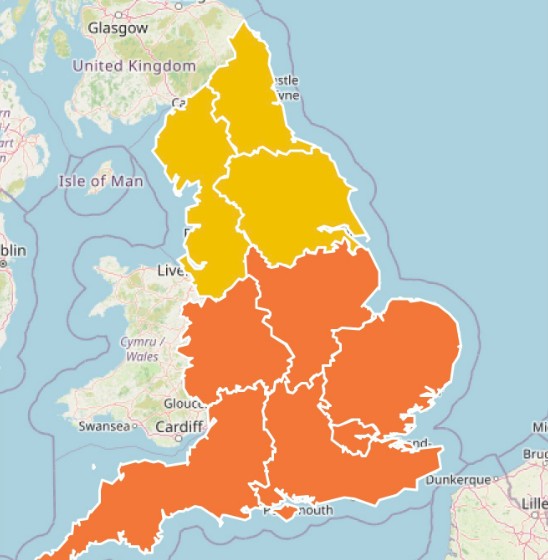
The UK Health Security Agency (UKHSA) and the Met Office have issued an Amber Heat-Health Alert across almost all regions of England as temperatures climb to the mid-30s. Critical safety warnings have been elevated for a severe surge in ‘thunderstorm asthma’, threatening millions of respiratory sufferers as electrical storms cause high pollen clouds to fracture.
- Amber Alert Extended: The enhanced response level covers nearly all English regions, warning that population-wide health impacts and widespread infrastructure disruption are imminent.
- Respiratory Emergency: Violent storm updrafts are expected to fragment grass pollen into sub-micronic particles, triggering severe, sudden asthma attacks deep within the lungs.
- Critical Transport Interventions: Network Rail has initiated precautionary speed restrictions to counter rail buckling as steel temperatures breach critical safety thresholds.
What Is Triggering the Current UK Heatwave Alert?
A high-pressure system drawn from the Continent has trapped hot air across the British Isles, prompting the UK Health Security Agency (UKHSA) to escalate its Weather-Health Alerting system.
An Amber alert signifies that weather impacts will be felt across the entire health service, with the wider population facing acute physiological risks.
🟠⚠️ An Amber Heat-Health Alert has been issued across the Midlands and southern England, with a Yellow Heat-Health Alert in place across Yorkshire and northern England. These alerts will be in place until Sunday 12 July. pic.twitter.com/lyUpd4SJgj
— UK Health Security Agency (@UKHSA) July 6, 2026
The primary defence of the human body against overheating is perspiration, coupled with increased blood circulation to the skin. However, persistent high humidity and a lack of convective breeze are currently disrupting this natural cooling process.
This leaves individuals vulnerable to heat exhaustion and heatstroke, a medical emergency requiring immediate hospitalization.
Why Has the Thunderstorm Asthma Hazard Level Been Raised?
The most critical development of this hot spell is the sudden rise in thunderstorm asthma risk across England. This phenomenon occurs when powerful updrafts from advancing summer storms sweep whole grass pollen grains and fungal spores into the upper humid layers of the atmosphere.
Once inside the cloud base, osmotic pressure causes these pollen grains to burst, dividing them into thousands of miniature particles.
When carried back down by cold storm downdrafts, these fragments are small enough to pass directly through the nasal passages and be inhaled deep into the lungs.
This creates a severe respiratory hazard for the UK’s estimated 5.4 million asthma sufferers and over 10 million seasonal hay fever patients.
How Is the Extreme Heat Damaging UK Infrastructure and Council Budgets?
The prolonged nature of this hot spell is triggering significant economic consequences, putting severe strain on localized transport networks and local authorities.
Transport Networks Face Structural Strain
The Department for Transport (DfT) has collaborated with Network Rail to implement speed limits across key commuter networks, including Transport for London (TfL) overground paths and major southern lines. Steel railway tracks absorb solar radiation and can exceed ambient air temperatures by over 20°C.
When internal steel temperatures breach 50°C, the risk of rail buckling elevates exponentially, forcing operators to slow trains down to reduce mechanical stress.
Simultaneously, on highway networks managed by National Highways, high asphalt temperatures have forced local council highways departments to prepare gritters to spread sand across softening road surfaces.
Local Government Financial Depletion
Under statutory obligations outlined in the UK Government’s Adverse Weather and Health Plan (AWHP), local authorities are facing unexpected social care costs. Councils must deploy staff for emergency welfare checks on vulnerable individuals living independently, as indoor environments quickly overheat.
Furthermore, the surge in public migration to rivers, reservoirs, and coastal areas has forced emergency services to reallocate diminishing budgets to combat cold-water shock and accidental drowning incidents.
What Are Medical Chiefs and Climate Experts Saying?
Sustained periods of warm weather can result in serious negative health outcomes across the population, so everyone must take sensible precautions while enjoying the sun. Dr Agostinho Sousa, Head of Extreme Events and Health Protection at UKHSA
Hay fever can cause asthma symptoms to worsen and thunderstorm conditions can cause even mild symptoms to become severe, such as difficulty breathing and chest tightening.
Anyone affected must ensure they keep their reliever inhalers close at hand. Amena Warner, Head of Clinical Services at Allergy UK
What Is the Meteorological Timeline for the Rest of the Week?
The Met Office confirms that the current Amber alert framework will remain active through the upcoming weekend.
A weak, cooler front approaching from the north will offer minor daytime relief to Scotland and parts of the North East. However, the southern half of England will continue to experience tropical nights, where urban temperatures fail to drop below 20°C.
Long-term meteorological projections indicate that due to shifting global baselines, summer heatwaves in the UK will continue to become more frequent, prolonged, and intense over the next decade.