
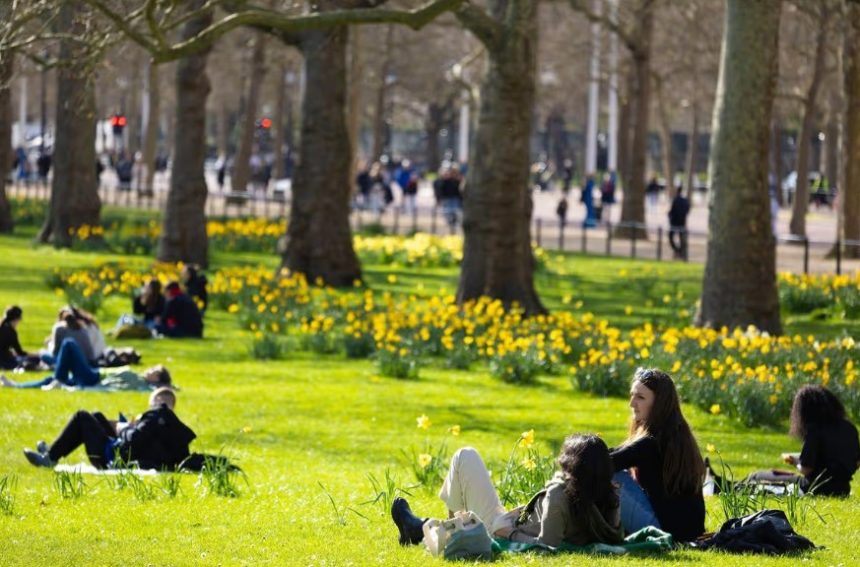
The United Kingdom is currently locked in a dramatic atmospheric tug-of-war as a significant “Spring Surge” arrives, with the uk weather forecast suggesting temperatures could climb as high as 20°C this week.
Following a period of unsettled Atlantic weather that brought 50 days of consecutive rain to parts of the South West earlier this winter, a dominant ridge of high pressure has established itself across the British Isles.
This shift marks a definitive move from wintry chills to early-season warmth. While much of England and Wales will bask in prolonged sunshine on Wednesday, March 18, and Thursday, March 19, a stubborn “cloud sandwich” remains over northern regions, creating a sharp and divided national picture.
Why is a 20°C ‘Mini-Heatwave’ Hitting the UK in March?
The primary driver behind this sudden spike in the uk weather forecast is a powerful area of high pressure building from the south-east.
This system has effectively “locked out” the Atlantic frontal zones that dominated February. According to the Met Office, the UK is currently poised to be warmer than traditional Mediterranean hotspots like Ibiza (16°C) and Zante (15°C).
The heat is being further intensified by a meteorological phenomenon known as the Foehn effect.
This atmospheric quirk follows a similar pattern to the 20C spring heat recorded recently, where south-easterly winds lose their moisture over UK high ground, warming significantly as they descend into western valleys.
As south-easterly winds lose their moisture over UK high ground, such as the mountains of Eryri (Snowdonia) and the Brecon Beacons, the air warms significantly as it descends into western valleys.
This explains why the highest temperatures are often recorded in unconventional spots like west Wales and north Devon, rather than just the South East.
Which UK Regions Will See the Most Sun?
The impact of this high-pressure system is not uniform across the four nations. The UK is currently split into three distinct weather zones:
After a chilly start, cloud becomes confined to Northern Ireland and parts of Scotland
Brighter and sunnier conditions for England and Wales as temperatures creep up through the morning in light winds pic.twitter.com/nIcuSOz74q
— Met Office (@metoffice) March 17, 2026
The “Sunshine Zone” (Southern England, Midlands, and Wales)
The most dramatic warmth is concentrated here. Cities including London, Bristol, Cardiff, and Birmingham are seeing wall-to-wall sunshine. Parts of the West Country and the Welsh coast are the “hot spots,” with the Met Office identifying potential highs of 19°C or 20°C.
The “Cloudy Corridor” (Northern England and Southern Scotland)
A weakening weather front has become “trapped” under the high pressure. This is affecting cities such as Newcastle, Leeds, and Edinburgh, where cloud cover remains stubborn.
While it remains dry, the lack of sun means temperatures here are suppressed, hovering around a more modest 11°C to 13°C.
The “Bright North” (Western Highlands and Moray Coast)
Interestingly, northern Scotland is faring better than the Borders. Thanks to the Foehn effect, the Moray Firth and parts of the Western Highlands are enjoying bright intervals and temperatures well above the seasonal average for the latitudes.
What are Met Office Experts Saying About the High Pressure?
Dan Harris, Chief Forecaster at the Met Office, issued a statement on Monday, March 16, detailing the expectations for the week: “Wednesday looks likely to be the warmest day of the week for many.
We are seeing a significant boost from east to south-easterly winds. While 20°C is possible, we are also reminding the public of the big diurnal range, the difference between daytime highs and nighttime lows.
Thanks to the clear skies, we’ll see some chilly nights with a few places experiencing air frost.”
This “Spring Surge” follows the warmest March 5th on record earlier this month, where temperatures peaked at 19.2°C in Northolt, West London.
If the mercury hits 20°C this Wednesday, it will officially mark the hottest day of the year so far for the United Kingdom.
How will the ‘Pollen Bomb’ and Morning Fog Affect the Public?
The sudden rise in temperature brings several practical challenges for UK residents and commuters:
- The “Pollen Bomb”: The warmth has triggered an early release of tree pollen, specifically Birch and Alder. Pharmacies across the South East report an unseasonal spike in demand for antihistamines.
- Commuter Fog: National Highways has warned of dense fog patches during the morning commutes on the M4, M5, and M25. This “radiation fog” forms quickly under clear night skies and can reduce visibility to less than 100 metres in rural valleys before burning off by mid-morning.
- Health Hazards: The UK Health Security Agency (UKHSA) notes that prolonged high pressure can lead to stagnant air. Coupled with potential Saharan dust being pulled up from the south, those with respiratory conditions are advised to monitor local air quality.
Is ‘Climate Whiplash’ Heading for the UK Next Week?
While the current uk weather forecast remains settled through Thursday, March 19, the outlook for the weekend suggests a return to reality.
Long-range modeling indicates that the high pressure will slide towards the Atlantic by Friday, allowing cooler, northerly winds to descend.
By Sunday, March 22, the UK is expected to transition into a more “unsettled” phase. This “climate whiplash”, a term used to describe the rapid swing between weather extremes, could see temperatures drop back to 9°C or 10°C by Monday, accompanied by blustery showers in the north.
The Met Office long-range outlook (March 22–31) suggests the month may end on a much more typical, changeable spring note.