


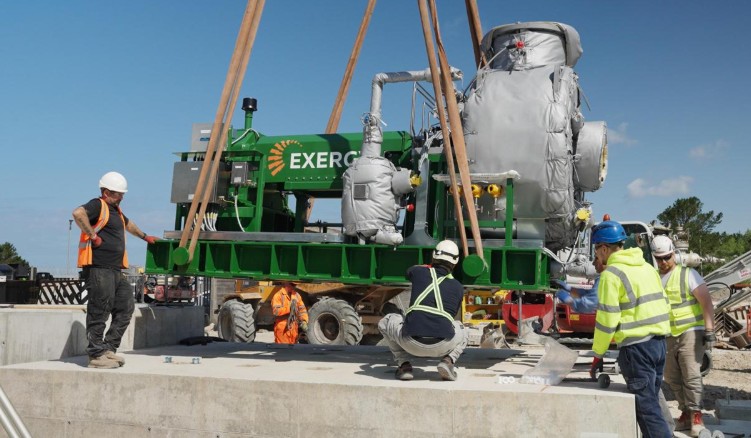
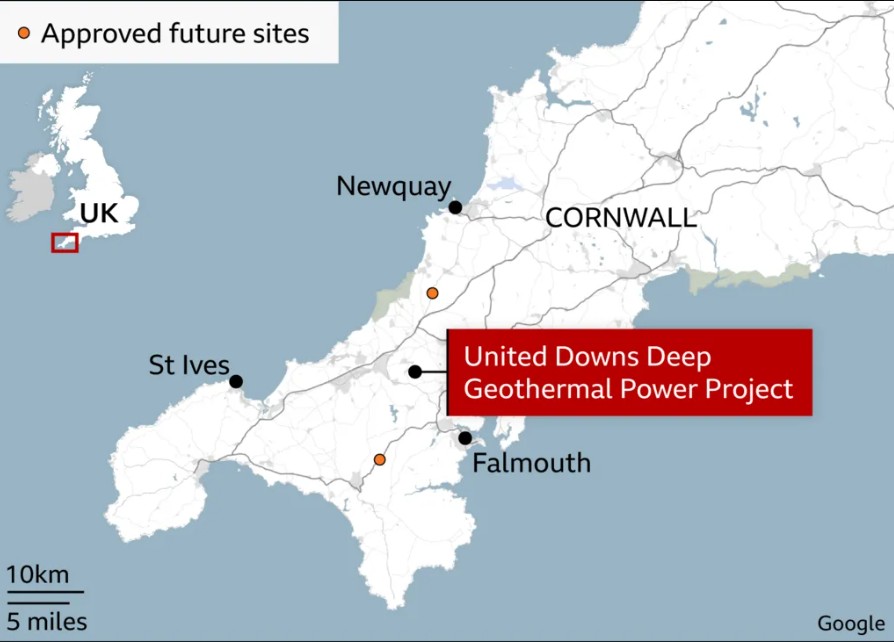
The UK’s first deep UK geothermal energy project will officially go live in Cornwall on Thursday, marking a major milestone for Britain’s renewable energy sector.
The plant, developed by Geothermal Engineering Ltd (GEL) at United Downs, will generate round-the-clock electricity for up to 10,000 homes while also producing the UK’s first domestic supply of lithium.
After nearly 20 years of development and £50 million in investment, the site represents a new chapter in home-grown clean energy.
The project matters because it introduces a constant, “always-on” renewable power source at a time when the UK faces rising electricity demand and energy security concerns.
How Does the UK Geothermal Energy Project Work?
The Cornwall plant taps heat stored deep within the Earth. Engineers drilled the deepest onshore well in UK history into granite rock, reaching temperatures close to 200°C several miles below the surface.
Dr Monaghan, head of geothermal at the British Geological Survey (BGS), explained: “You drill deep boreholes into the ground, and then fractures within the granite rock are used to circulate the water that picks up the heat used for electricity production.”
The super-heated water rises to the surface and drives turbines to generate electricity. Unlike wind or solar, geothermal energy runs 24 hours a day, seven days a week.
Granite plays a key role because it holds and conducts heat efficiently, something Cornwall’s geology offers in abundance.
Why Is This Project Significant for UK Energy Security?
Ryan Law, CEO of GEL, said after 15 years of work: “I’m tremendously excited after 15 years of hard graft, difficulties, we’re finally there.”
He added that geothermal power avoids gas price volatility and delivers stable output regardless of weather.
The electricity generated at United Downs has been sold to Octopus Energy, which will distribute it via the National Grid to homes across Britain.
An Octopus spokesperson described it as: “A genuine game-changer… providing a steady stream of clean, home-grown energy.”
At present, most UK renewable electricity comes from wind and solar. However, both depend on weather conditions. Geothermal offers baseload power, meaning it runs continuously.
How Much Has the Project Cost?
The project has cost £50 million to date. Funding came from private investors and £15 million from the European Development Fund, accessed before Brexit.
While the British Geological Survey has called it a “major step forward”, high drilling costs remain a barrier. Deep geothermal requires expensive exploratory drilling, with most costs paid upfront before energy generation begins.
Anne Murrell, head of industry body Geothermal UK, said: “We have a great energy resource underneath our feet in the UK, but we’re not maximising its potential.”
She added that government backing will prove crucial to unlock further private investment.
In 2023, the government appointed Lord Whitehead as the UK’s first geothermal minister, signalling growing political interest in the sector.
Could Other Parts of the UK Benefit?
Deep geothermal electricity is technically possible in Scotland and the North East of England, although no approved projects currently exist there.
Meanwhile, shallow geothermal systems already operate in parts of Britain. There are currently around 30,000 ground source heat pumps installed in UK homes.
The government offers grants under schemes such as the Boiler Upgrade Scheme to reduce installation costs.
A practical example comes from Gateshead Council, which heats hundreds of homes using warm water from flooded former coal mines. Around a quarter of UK homes sit above abandoned coal mines, offering future potential.
Across Europe, the Netherlands aims to heat 25% of homes using geothermal energy by 2050.
What About Lithium Production?
In addition to electricity, the UK geothermal energy project will extract lithium carbonate from underground fluids. Lithium is critical for electric vehicle (EV) batteries and other green technologies.
The Cornwall site will initially produce around 100 tonnes of lithium per year, enough for batteries in roughly 1,400 EVs annually. GEL plans to scale production to 18,000 tonnes per year in future phases.
According to the British Geological Survey, UK lithium demand could rise between 12 and 45 times during the 2020s due to the growth of electric vehicles and battery storage.
The UK government has provided a £1.8 million grant, covering 50% of the initial lithium extraction costs.
How Is Global Demand Driving Geothermal Growth?
The International Energy Agency reports that global investment in deep geothermal electricity has risen by 80% year-on-year since 2018.
Technology firms such as Google, Meta and Microsoft are increasingly exploring geothermal energy to power energy-hungry data centres.
Data centres require a constant electricity supply. Geothermal provides that stability while cutting carbon emissions.