
A sudden increase in US military aircraft movements across Britain has drawn public attention, defence analysis, and political debate.
The aircraft activity, observed over the weekend, comes at a time of heightened global instability and renewed international concern over US foreign policy rhetoric linked to former President Donald Trump.
Although the UK Ministry of Defence (MoD) has not issued a formal statement, open-source flight data and defence experts confirm that Britain is once again serving as a critical logistical hub for the United States and NATO allies.
What US military aircraft have arrived in the UK?
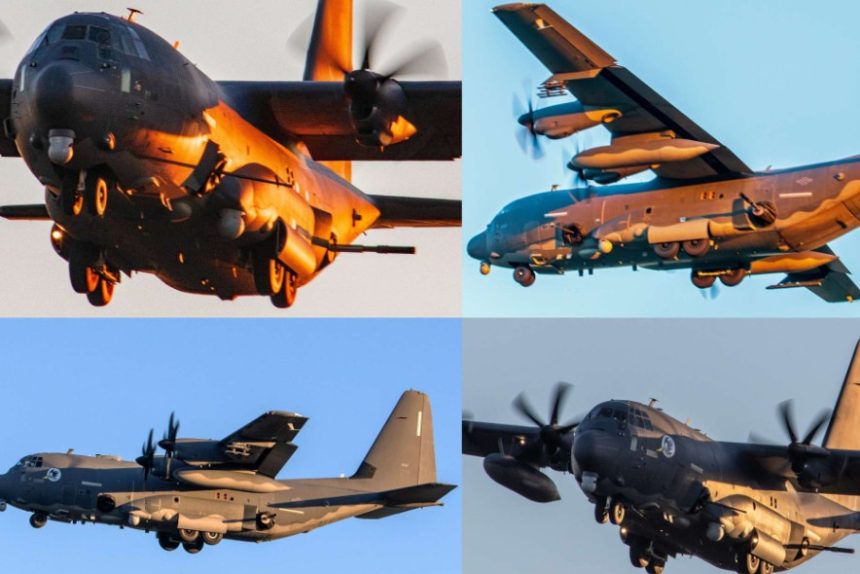
Since Saturday, at least 14 US Air Force C-17 Globemaster III transport aircraft and two AC-130J Ghostrider gunships have landed at multiple RAF bases in England.
These aircraft were tracked arriving in clusters rather than isolated landings, suggesting a coordinated movement rather than routine training flights.
The landings were confirmed at three long-established RAF sites used by American forces: RAF Fairford in Gloucestershire, RAF Mildenhall, and RAF Lakenheath in Suffolk.
RAF Fairford, in particular, is widely regarded by defence planners as the primary US airbridge into Europe, allowing rapid movement of troops and heavy equipment.
Several of the aircraft were later observed departing the UK and flying onwards to Ramstein Air Base in Germany, a major NATO command and logistics centre, reinforcing the view that the UK is being used as a staging and transit point.
What equipment is believed to be onboard?
While official cargo manifests have not been released, defence analysts believe the C-17 Globemasters were transporting specialist aviation equipment typically used by US special operations forces.
These aircraft are designed to carry oversized and sensitive military hardware quickly and discreetly.
Most analysts point to the movement of:
- MH-60M Black Hawk helicopters
- MH-47G Chinook helicopters
Both aircraft types are associated with high-risk missions, including night-time insertions and rapid extraction operations. Their presence does not confirm an active operation but does indicate elevated readiness.
Why is the UK central to these movements?
Britain’s role is largely strategic rather than political. The UK offers secure airspace, long-established defence agreements with the US, and infrastructure capable of handling heavy military aircraft at short notice.
RAF Fairford’s long runway and specialised facilities make it particularly suitable for rapid deployments into Europe, the Middle East, or North Africa.
A former RAF logistics officer previously explained to UK broadcasters that Britain provides “depth and discretion” for American forces, allowing preparations to take place away from immediate conflict zones.
Are global tensions driving the aircraft surge?
The timing of the aircraft arrivals has coincided with several international flashpoints.
These include continued unrest in the Middle East, renewed concerns over Iran’s handling of civilian protests, and escalating political language from Donald Trump during campaign appearances in the United States.
Trump recently warned of a strong American response if violence against demonstrators continues abroad, stating in a public address: “America will come to their rescue… we are locked and loaded and ready to go.”
While such statements have intensified online speculation, UK defence analysts stress that military movements into Britain do not automatically signal an imminent strike or conflict.
Why is the AC-130J Ghostrider significant?
The arrival of the AC-130J Ghostrider has attracted particular attention because the aircraft is purpose-built for combat support rather than transport.
It is one of the most heavily armed aircraft in active service and is typically deployed only when the US wants to maintain immediate strike capability.
Publicly known features of the Ghostrider include:
- A 30mm automatic cannon
- A 105mm howitzer
- Precision-guided missiles and advanced surveillance systems
Its presence in the UK is uncommon but not unprecedented, often linked to contingency planning or joint NATO exercises rather than active combat missions.
What is the UK government’s position?
The Ministry of Defence has declined to comment, reiterating its long-standing policy of not discussing the operational movements of allied forces.
US aircraft have been stationed in the UK for decades under existing defence agreements, and temporary increases in activity are not unusual during periods of strategic uncertainty.
UK officials have privately indicated that there is no immediate threat to public safety and no change to domestic security posture.