


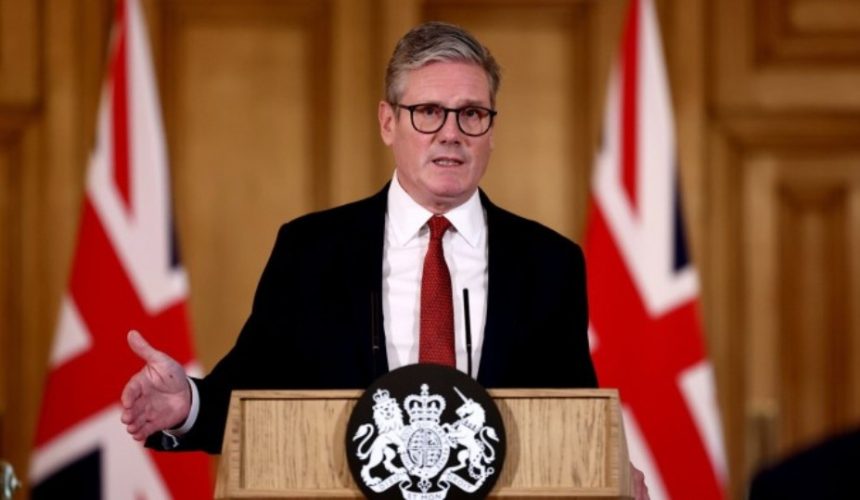
In a move that has sent shockwaves through Westminster and Tehran alike, Prime Minister Sir Keir Starmer has formally authorised the United States to utilize sovereign British military bases for offensive-defensive strikes against Iranian territory.
This decision marks a departure from previous “restraint-only” policies, specifically aimed at breaking the Iranian blockade of the Strait of Hormuz.
The authorisation allows President Donald Trump’s administration to coordinate heavy sorties from RAF Fairford in Gloucestershire and the strategically vital Diego Garcia.
While the government maintains this is a legal act of “collective self-defence,” critics argue the UK has now been tethered to a potentially uncontrollable escalation in the Middle East.
Why has the UK shifted its policy on US base usage?
For months, the Labour government insisted that US operations from British soil be limited to “defensive” maneuvers protecting immediate British assets.
However, the total blockade of the Strait of Hormuz, through which 20% of global oil flows, has changed the calculus in Downing Street.
BREAKING: UK IS COMPLICIT IN IRAN WAR
The B-52 aircraft belonging to the US are returning to the British Air Force base in Fairford, England, after a military mission in Iran.
Keir Starmer is lying to you, US soldiers are literally loading 2,000lb bombs onto B-52s at RAF… pic.twitter.com/jZYjqnfLmD
— Sulaiman Ahmed (@ShaykhSulaiman) March 20, 2026
Following a localized Cabinet meeting on Friday, the government concluded that the economic strangulation of the UK was an act of aggression that justified a “degrade and destroy” mission against the missile sites located on Iran’s coastline.
By allowing the US to use RAF Fairford, the UK is providing the necessary infrastructure for long-range B-52 and B-1B bombers to operate, assets that are essential for hitting hardened Iranian missile silos.
Where are the primary launch sites, and why are they targets?
The geography of this conflict spans from the English countryside to the heart of the Indian Ocean.
- RAF Fairford (Gloucestershire): As the only “forward operating location” for US heavy bombers in Europe, Fairford is the logistical backbone of this agreement. Its long runways allow for the deployment of aircraft capable of carrying massive payloads required to neutralise Iran’s coastal “A2/AD” (Anti-Access/Area Denial) bubbles.
- Diego Garcia (BIOT): Located in the British Indian Ocean Territory, this base allows the US to strike Iranian targets without needing permission from nervous Gulf allies like Qatar or Kuwait, who fear direct Iranian surface-to-surface missile retaliation.
- The Strait of Hormuz: This 21-mile-wide chokepoint is the “battlefield.” Iran’s use of “suicide” drones and anti-ship cruise missiles here has effectively turned the waterway into a no-go zone for international tankers.
How has Iran reacted to the “Participation in Aggression”?
The response from Tehran was swift and chilling. Foreign Minister Abbas Araghchi used social media and diplomatic channels to label the UK an “active participant” in the conflict.
The Iranian Ministry of Foreign Affairs has suggested that by providing the “bullets and the launchpads,” the UK has forfeited its status as a non-combatant. In a Telegram post, Araghchi hinted at “reciprocal measures,” leading to fears of:
- Cyber-attacks on UK critical national infrastructure (NHS, National Grid).
- Proxy strikes against British interests in Iraq or Cyprus.
- Direct threats to the British personnel stationed at “HMS Juffair” in Bahrain.
What are the legal justifications for “Collective Self-Defence”?
Downing Street is leaning heavily on Article 51 of the UN Charter. The legal argument presented by the Attorney General is that the blockade of international waters constitutes an armed attack on the global economy and the security of sovereign states.
By framing the strikes as “defensive operations to degrade capabilities,” the UK seeks to avoid the legal pitfalls of the 2003 Iraq War.
However, international law experts warn that “pre-emptive” strikes on missile sites that have not yet fired can be difficult to defend in the International Court of Justice.
Will this decision lead to a “Summer Energy Shock” for UK households?
The primary driver behind Starmer’s decision is the domestic “Cost of Living” crisis. The effective closure of the Gulf has already caused Brent Crude to surge.
- Projected Impact: Energy analysts suggest that if the US-UK strikes fail to reopen the Strait quickly, energy bills could rise by an additional £300 this summer.
- Supply Chains: Beyond fuel, the detour of container ships around the Cape of Good Hope adds 10–14 days to shipping times, threatening the availability of goods in UK supermarkets and increasing “imported inflation.”
What is the domestic political fallout in Westminster?
The Prime Minister is facing a pincer movement from the Left and the Right.
- The Opposition: Conservative leader Kemi Badenoch has accused the PM of “weakness,” claiming the delay in granting base access allowed Iran to dig in.
- The Liberal Democrats: Calum Miller has demanded a “War Powers Act” style vote in the House of Commons, arguing that such a significant military escalation requires a democratic mandate.
- The Labour Backbench: There are growing murmurs of dissent among Labour MPs who fear the UK is being “manhandled” into a war by President Trump’s “America First” agenda.
The Risk of the “Slippery Slope”
By granting the US use of bases for strikes inside Iran, the UK has crossed a Rubicon. Previously, UK involvement was limited to intercepting drones over international waters (as seen in previous Red Sea operations).
However, the mission is rapidly expanding as the UK sending military to US assets becomes a reality to coordinate these high-stakes sorties.
If the US proceeds with reported plans to occupy Kharg Island, the UK may find itself under immense pressure to provide naval escorts or “boots on the ground” to hold captured territory. This is the “slippery slope” that the Liberal Democrats and anti-war campaigners are currently highlighting.
Official Statements and Verification
- Foreign Office (FCDO): Confirmed that Yvette Cooper warned Iran against “targeting UK bases” directly.
- The White House: President Trump stated, “They were really, pretty much our first ally… it took a while, but we’re there.”
- Local Authorities: Police in Gloucestershire have reportedly reviewed security protocols around RAF Fairford following the announcement.