
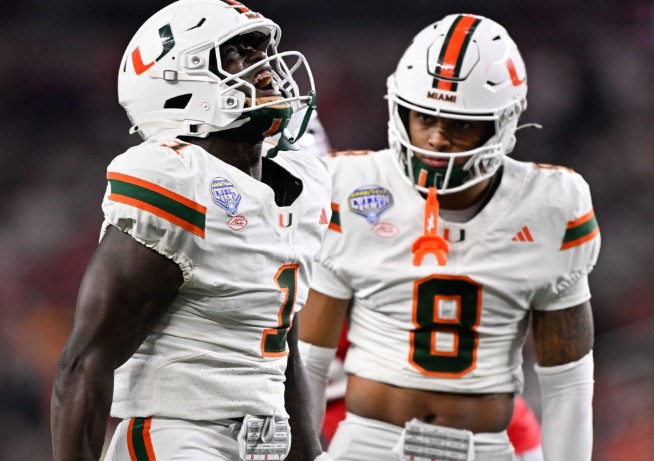
Miami have pulled off one of the biggest upsets in College Football Playoff (CFP) history, knocking out defending champions Ohio State with a 24–14 win at the Cotton Bowl in Texas.
For UK sports fans less familiar with American college football, this result is the equivalent of a lower-seeded FA Cup side dumping out the reigning Premier League champions on a neutral ground.
The victory sends Miami into the CFP semi-finals and keeps alive their dream of a first national title in more than 20 years.
What happened in the Miami vs Ohio State CFP quarter-final?
Miami, seeded 10th in the new 12-team CFP format, stunned second-seeded Ohio State on Wednesday night in Arlington, Texas.
The Hurricanes raced into an early lead thanks to two first-half touchdowns and never allowed Ohio State to recover. The final score, Miami 24, Ohio State 14, marked the most points the Buckeyes conceded all season.
Key match facts:
- Venue: Cotton Bowl, Arlington, Texas
- Attendance: Over 90,000
- Final score: Miami 24–14 Ohio State
- Date: Wednesday night (UK early hours Thursday)
This was Miami’s second straight playoff win, despite not even playing in their Atlantic Coast Conference (ACC) championship game earlier in the season.
Who were the standout performers?
Miami defensive back Keionte Scott delivered the decisive moment of the match. He intercepted a screen pass and ran 72 yards for a touchdown, giving Miami a commanding 14–0 lead midway through the second quarter.
It was Scott’s second interception return touchdown of the season, a rare and momentum-shifting play at this level.
“This is a joint team effort and a family. We’re progressing, we’re getting better and better,” said Miami head coach Mario Cristobal, speaking after the game.
How did Miami’s offence control the game?
Quarterback Carson Beck played a calm and efficient game, completing 19 of 26 passes for 138 yards and a touchdown.
He connected with running back Mark Fletcher Jr. for a nine-yard score and helped set a Cotton Bowl record with 13 consecutive completed passes.
#2 Ohio State Vs. #10 Miami. #CollegeFootball #OhioState #JeremiahSmith #JulianSayin #BoJackson #Miami #MarioCristobal #RuebenBainJr. #JakobeThomas #CarsonBeck #MarkFletcherJr #CollegeFootballPlayoffs pic.twitter.com/P9jf9pobQW
— soundtheory22 (@EclecticRiddims) January 1, 2026
Fletcher Jr. was named offensive MVP, rushing 19 times for 90 yards and consistently draining the clock.
What went wrong for Ohio State?
Ohio State entered the game as 9.5-point favourites, according to BetMGM Sportsbook, but struggled with turnovers and pressure.
Freshman quarterback Julian Sayin, stepping in after last season’s title run, threw two interceptions and was sacked five times. Despite throwing for 287 yards, his mistakes proved costly.
Wide receiver Jeremiah Smith, a Miami native, impressed with 157 receiving yards and a touchdown, but Ohio State failed to convert key moments into points.
This defeat also means Ohio State have now failed to win back-to-back national titles for the first time in their programme’s history.
Why is this win such a big deal for Miami?
Miami last won the national championship in 2001. Remarkably, current head coach Mario Cristobal was part of that title-winning team as an offensive lineman.
The Hurricanes came painfully close to defending that crown in 2002 but lost in double overtime to Ohio State in the Fiesta Bowl. This win, therefore, carries added emotional weight for the programme.
Who will Miami face next in the CFP semi-finals?
Miami now advance to the CFP semi-final at the Fiesta Bowl on 8 January, where they will face either:
- Georgia (No. 3 seed), or
- Ole Miss (No. 6 seed)
Both teams play in the Sugar Bowl later this week.
One more win would send Miami to the national championship game, which will be played in their home stadium, a rare and significant advantage.
How does the new CFP format affect this result?
This season is only the second year of the expanded 12-team College Football Playoff, introduced to give more teams a realistic shot at the title.
Interestingly, all four teams that received first-round byes last season were eliminated at the quarter-final stage, a trend that has now continued with Ohio State’s exit.
For neutral fans, including UK viewers, the format has delivered more drama, more upsets, and more meaningful games.