


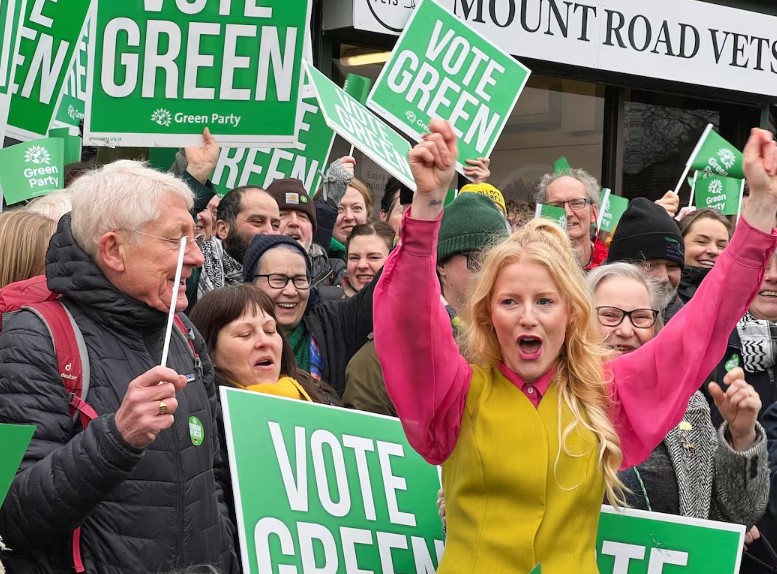
Labour has suffered a dramatic defeat in the Keir Starmer by-election test after the Green Party overturned a 13,000-vote majority to win the Gorton and Denton seat in Greater Manchester.
Voters headed to the polls on Thursday in the south-east Manchester constituency, with results declared overnight at Manchester Central Convention Complex.
The shock outcome pushes Sir Keir Starmer’s leadership into fresh political scrutiny and reshapes the battle for progressive voters in the North West.
The Greens secured 14,980 votes, pushing Reform UK into second place and relegating Labour to third in what many insiders describe as a “vote of public confidence” in the Prime Minister’s leadership.
Turnout reached 47.62 per cent, with 36,903 verified votes cast, slightly down from 47.8 per cent recorded during the 2024 General Election.
How did the Greens overturn Labour’s 13,000 majority?
The scale of the swing stunned party officials across Westminster.
The seat was previously held comfortably by Labour following the 2024 General Election. But the resignation of former MP Andrew Gwynne after offensive WhatsApp messages triggered the by-election and left the party exposed locally.
🚨 Breaking: GORTON AND DENTON BY-ELECTION RESULT
Hannah Spencer of the Green Party takes the Gorton and Denton seat.
Palestine and Illegal family voting has robbed the British people of true democracy.
Are we now entering a new era of Muslim vote rigging? pic.twitter.com/24yPFPDDIo
— WeGotitBack 🏴🇬🇧🇺🇸 (@NotFarLeftAtAll) February 27, 2026
Green candidate Hannah Spencer, backed by London Assembly member Zack Polanski, ran a tightly focused campaign.
The party framed the vote as a two-horse race between themselves and Reform UK, urging progressive voters to switch from Labour.
A Green Party source said: “We’ve said from the start we’re not here to be disappointed by Labour, but we’re here to replace them.”
Labour deputy leader Lucy Powell appeared to concede the point. She said: “The Greens have managed to win that argument that they were best placed to block Reform UK.”
Why does this Keir Starmer by-election defeat matter nationally?
This contest was only the second parliamentary by-election under Sir Keir’s government. Losing a previously safe Labour seat in Greater Manchester raises deeper questions about voter confidence.
In 2024, Labour secured the seat with a majority exceeding 13,000. Just 18 months later, the party slipped to third place. That swing signals more than local dissatisfaction; it suggests fragmentation on the centre-left and growing pressure from smaller parties.
Reform UK’s candidate, political commentator Matt Goodwin, improved on the party’s 2024 performance and finished second. While Reform did not win, its surge forced tactical voting on the left, benefiting the Greens.
For Sir Keir Starmer, this defeat fuels claims that Labour’s traditional base feels restless, particularly in urban northern constituencies.
What happened with the “illegal family voting” row?
The by-election also became embroiled in controversy after watchdog group Democracy Volunteers reported “unprecedented” levels of family voting.
Observers attended 22 of the 45 polling stations and recorded:
- 32 incidents across 545 voters sampled
- Family voting in 15 of the 22 stations observed
- 68% of monitored stations affected
- Around 12% of voters in the sample were involved
By comparison, the recent Runcorn and Helsby by-election saw family voting in just 12 per cent of polling stations, affecting roughly 1 per cent of voters.
Family voting, where relatives enter booths together and potentially influence each other, became a criminal offence under the Ballot Secrecy Act 2023.
John Ault, director of Democracy Volunteers, said: “Today we have seen concerningly high levels of family voting in Gorton and Denton.”
Meanwhile, Matt Goodwin said he was “deeply concerned” about whether the election was fully free and fair.
Zack Polanski told BBC Newsnight he would support further investigation if required.
How did Labour respond on the ground?
Labour insisted it mounted a significant ground operation, with more than 1,000 activists campaigning across the constituency.
Greek-born local councillor Angeliki Stogia stood as the Labour candidate after Greater Manchester Mayor Andy Burnham was reportedly overlooked by the party’s National Executive Committee.
Party insiders had warned earlier in the night that the race would be “very close.” However, internal sources later acknowledged the Greens had succeeded in turning out support in a way that “wouldn’t be replicated at a General Election.”
Where does this leave UK politics?
The result marks one of the most symbolic Green victories in recent parliamentary history. It strengthens the party’s claim to be a serious challenger in urban Labour heartlands.
For Reform UK, finishing second in a traditionally Labour stronghold reinforces its growing presence in English politics.
For Labour, and for the Prime Minister, this Keir Starmer by-election defeat lands at a sensitive moment. It sharpens debate about voter trust, party strategy, and whether Labour can hold together its broad coalition ahead of future national contests.