


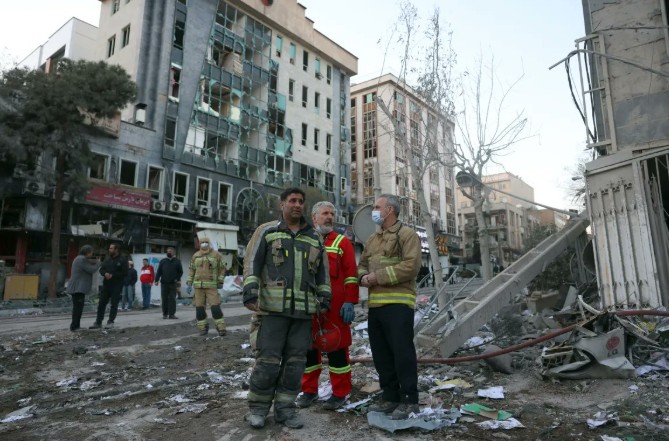
Israeli forces have launched simultaneous strikes in Tehran and Beirut, claiming they are targeting military installations linked to Iran and the Iran-backed militia group Hezbollah.
The Israeli strikes come amid rising tensions after earlier claims that missile sites and air defences capable of targeting Israeli aircraft were destroyed.
The developments mark a significant escalation in a conflict that now stretches across the Middle East and risks wider regional instability.
The Israeli military says its operations are defensive and aimed at preventing future attacks on its territory. Meanwhile, Hezbollah has retaliated with a drone strike on the Ramat David airbase, claiming it targeted radar and control facilities.
The escalation builds on events surrounding the US embassy in Riyadh and wider regional tensions that have shaped relations between Tehran and neighbouring powers.
Israeli authorities argue the operations are defensive, aimed at preventing future attacks on Israeli territory. Iran and Hezbollah reject that framing, describing the strikes as violations of sovereignty and acts of aggression.
Casualty figures continue to emerge, with reports of dozens killed and hundreds injured in recent air raids on Lebanon. Here’s what has happened, why it matters, and how it could impact the UK and international security.
What are the Israeli strikes targeting in Tehran and Beirut?
Israeli forces say they are hitting military objectives linked to Iranian operations and Hezbollah infrastructure. According to the military, installations designed to launch missiles against Israel were targeted to reduce the threat of future attacks.
The Israeli military also stated it intends to continue strikes against “live fire sites, missile launchers, and ballistic missiles” in an effort to dismantle capabilities it sees as hostile.
🇮🇱🇮🇷 The Israeli Air Force has launched a large-scale wave of strikes on Beirut and Tehran simultaneously.
According to Yediot News, Israeli aircraft are targeting military-industrial facilities in Tehran as well as missile sites in central Iran.#Caliber #Israel #Iran… pic.twitter.com/aGzlqZIAQ0
— Caliber English (@CaliberEnglish) March 3, 2026
In Tehran, details remain limited, but Iranian officials have confirmed explosions near military areas. The Iranian government has condemned the strikes as a violation of sovereignty and vowed to respond.
In Beirut, airstrikes have focused on the southern suburbs and areas linked to Hezbollah operations. Reports from Lebanese authorities state that at least 52 people have been killed and 154 injured following recent raids.
Why are Israeli troops in southern Lebanon?
The Israeli military says it has deployed troops along the southern Lebanese border as part of a “forward defence” strategy. Officials insist this is not a full ground invasion but a tactical measure to protect Israeli civilians and prevent cross-border attacks.
Lieutenant Colonel Nadav Shoshani of the Israeli military stated: “We have positioned soldiers on the border area in additional points to defend our civilians, to prevent Hezbollah from attacking them.”
He added that the operation aims to secure the border without expanding the conflict.
However, Lebanon’s state-run news agency reports that the Lebanese army is withdrawing from advanced positions near the border, raising concerns about a security vacuum in the area.
How is Hezbollah responding?
Hezbollah has launched a drone attack on the Ramat David airbase, targeting radar sites and control rooms. The group claims the strike was retaliation for Israeli operations in Lebanon.
On Monday, Hezbollah fired missiles and drones at Israeli military positions in Haifa, prompting further Israeli air raids.
The group maintains that its military actions are legitimate resistance to Israeli operations, despite the Lebanese government declaring its armed activities illegal.
What has the Lebanese government said?
The Lebanese government has formally declared Hezbollah’s military operations unlawful and urged security forces to prevent attacks launched from Lebanese territory.
However, Hezbollah rejected the decision, accusing the government of weakness and arguing that it has the right to resist Israeli actions.
A statement from the group said: “We understand the Lebanese government’s impotence in the face of the brutal Zionist enemy, which violates national sovereignty, occupies land, and poses a continuous threat to the country’s security and stability.”
The dispute highlights deep political divisions in Lebanon, where Hezbollah remains both a powerful militia and a significant political actor.
Why does this matter to the UK?
The escalation risks wider instability in a region already affected by prolonged conflict. The UK government has urged restraint and called for a diplomatic solution.
Britain maintains strategic interests in Middle Eastern security and has military personnel stationed in the region as part of international operations. Any prolonged conflict could impact energy markets, migration flows, and global security dynamics.
Foreign Secretary statements have emphasised the need to prevent civilian casualties and uphold international law.
The situation remains fluid. Further Israeli strikes and Hezbollah responses could push the conflict into new phases. Diplomatic efforts are ongoing, but trust between the parties remains low.
International observers warn that continued escalation could draw in regional powers and destabilise neighbouring countries.