


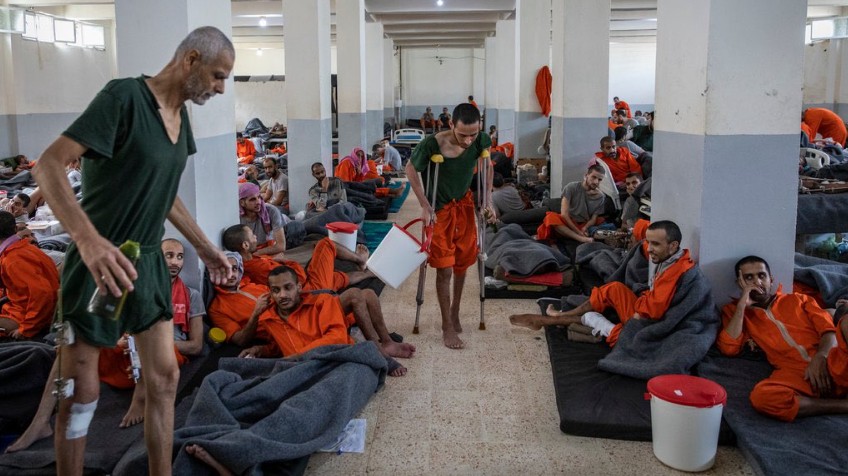
Iraq receives ISIS detainees after the United States began moving thousands of captured Islamic State fighters out of Syria, marking a major shift in how the region handles one of the world’s most dangerous extremist threats.
The US military confirmed this week that it has started transferring IS group detainees from prisons in north-east Syria to secure facilities in Iraq.
The move began on Wednesday, with around 150 detainees transferred first, and could eventually involve up to 7,000 prisoners.
The transfers come as Kurdish-led forces in Syria hand control of detention sites back to the Syrian government.
The decision matters because it changes who is responsible for guarding, prosecuting, and containing hardened IS fighters, many of whom are considered senior commanders, at a time when the group still poses a security risk in the Middle East and beyond.
Why is Iraq receiving ISIS detainees now?
The transfers follow political and military changes inside Syria. The Syrian Democratic Forces (SDF), backed by the US and led by Kurdish fighters, have controlled prisons holding thousands of IS detainees since the group’s defeat.
However, under a new peace process, the SDF is withdrawing from several areas and handing prisons back to the Syrian state.
US Central Command said moving detainees to Iraq reduces the risk of prison breaks during this transition.
“Facilitating the orderly and secure transfer of ISIS detainees is critical to preventing a breakout that would pose a direct threat to the United States and regional security,” Admiral Brad Cooper, Commander of US Central Command
Iraq has agreed to take the detainees as part of wider regional security cooperation with the US.
How many ISIS detainees are being transferred?
According to US and Iraqi officials:
- 150 detainees were transferred in the first phase (January 2026)
- Up to 7,000 IS group members could be moved in total
- Around 9,000 IS detainees remain held across more than a dozen facilities in Syria
- Many of those transferred are described as “first-tier leaders” within IS
An Iraqi intelligence official said the detainees include foreign nationals from Tunisia, Tajikistan, Kazakhstan, and Syria, alongside Iraqi nationals.
“All of them are commanders in ISIS and are considered highly dangerous,” a senior Iraqi intelligence general
Iraq confirmed that legal proceedings have already begun against the first group that arrived.
Where are the detainees coming from in Syria?
Most detainees are being moved from detention centres in Hassakeh province, in north-east Syria.
The situation there has been unstable. Syrian government forces recently took control of areas previously held by the SDF, including near Shaddadeh, where detainees escaped during clashes before many were recaptured.
An Urgent and Explicit Warning to the World – Defending the Kurds Means Defending Global Security
What is happening in Syria today is not normal, nor is it a mere “security failure.” It is a catastrophe in the making. The escape of ISIS detainees who were under… pic.twitter.com/OYp7clJ85R
— (Ocalan)اوجالان (@AOcalan2) January 21, 2026
NEW 🔴
U.S. Central Command said it launched a mission on Jan. 21 to transfer ISIS detainees from northeastern Syria to Iraq, moving 150 fighters from a facility in Hasakah.
CENTCOM said up to 7,000 ISIS detainees could eventually be relocated to Iraqi run facilities to prevent… pic.twitter.com/cu4c9DGznI
— Open Source Intel (@Osint613) January 21, 2026
The largest prison, Gweiran (Panorama) Prison, still holds around 4,500 IS-linked detainees and remains under SDF control for now.
What is happening at al-Hol camp?
While fighters are being transferred, thousands of women and children linked to IS remain stranded at al-Hol camp, one of the world’s most notorious detention camps.
Current figures show:
- Around 24,000 people still live at the camp
- 14,500 are Syrians
- Nearly 3,000 are Iraqis
- About 6,500 foreign nationals are held in a high-security section
Conditions remain poor. An Iraqi woman inside the camp told reporters:
“There are no clinics, no running water, no bread, and no vegetables.” Many residents are calling on their home governments to repatriate them.
Is ISIS still a threat despite its defeat?
Yes. Although IS was militarily defeated in Iraq in 2017 and Syria in 2019, the group still operates sleeper cells.
Last year alone:
- US and partner forces detained over 300 IS operatives
- More than 20 IS fighters were killed
- A recent ambush killed two US soldiers and an American civilian interpreter
The US says preventing prison escapes is vital to stopping a resurgence.
What does this mean for the UK and Europe?
Although the detainees are not being moved to Europe, the issue remains relevant for the UK:
- IS attacks in Europe have often involved returnees or inspired individuals
- Several European nationals, including French citizens, were previously transferred to Iraq for trial
- Stability in Iraq and Syria directly affects global terrorism risks
The UK government has long supported regional efforts to prosecute IS fighters close to where crimes were committed.