

Publicly owned operators are already showing what a unified system can achieve. Greater Anglia, which recently moved into public control, is performing impressively.
It was named Rail Operator of the Year at the 2025 National Transport Awards, following record punctuality and a fully modernised fleet across the region.
Some routes are hitting nearly 98% punctuality, with the network as a whole exceeding 93%, while Greater Anglia now holds all four major awards for operator excellence, something no private franchise achieved during the era of privatisation.
The operator’s managing director described the transition as a chance to strengthen collaboration with other publicly owned trains and maintain the high standard passengers expect.
The Anglia region is also testing the kind of leadership GBR hopes to implement nationwide.
A new integrated managing director oversees Greater Anglia, c2c, and Network Rail’s Anglia route, aiming to fix the long-standing disconnect between track and train operations and speed up problem-solving.
A New Identity and Ticketing Experience
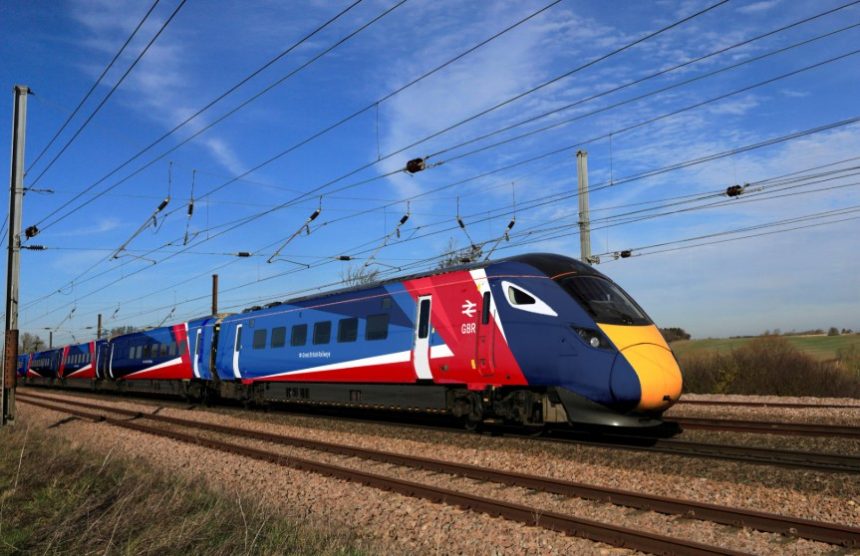
The branding reveal came alongside an exercise of the GBR marking app, which promises a simple way to buy tickets across the public rail network without reserving freights.
Availability features, like the capability to request backing at the time of purchase, are designed to make trips easier for impaired passengers.
Ministers also say GBR will simplify fare structures, continuing efforts to make rail travel fairer and more affordable.
Tomorrow the new blue, red & white GBR livery & brand will be launched. The new design will be displayed on digital displays at a number of stations. The DfT says the livery will appear across already publicly owned train operators from spring, with roll-out being gradual. DfT pic.twitter.com/q9lnBKbpEg
— Today’s Railways UK (@TodaysRailways) December 8, 2025
This year’s nationwide fare freeze, the first in three decades, was framed as a small but meaningful step in helping passengers during a period of high living costs.
Early Signs of Improvement Across Public Operators
Investments are already visible across publicly owned rail operators. South Western Railway has expanded its line of Arterio trains, adding capacity by nearly 10, while LNER is adding thousands of redundant services under a new schedule.
Drivers have also introduced advanced monitoring systems to detect faults before they disrupt peregrinations.
With profit no longer the main priority, public drivers can now concentrate on trustworthiness, long-term planning, and value for passengers, rather than short-term earnings.
Rail Industry Responds with Caution
Transport Focus, the independent watchdog, welcomed the GBR branding reveal and the parliamentary debate on its enabling legislation as steps towards a railway built around passengers.
But the organisation warned that success will depend on leadership, culture, and responsiveness, qualities that cannot simply be legislated.
Similarly, the Rail Delivery Group praised the reforms as a chance to unite an industry long divided into silos.
They stressed that effective collaboration between public operators and infrastructure bodies will be vital during the transition.
Challenges for Britain’s Railways
Despite the excitement, questions remain. The GBR rebrand will take years to appear consistently across trains, stations, and digital platforms.
The new organisation also inherits an ageing infrastructure, rising costs, recruitment challenges, and post-pandemic changes in travel behaviour.
Critics note that renationalisation alone doesn’t guarantee success. GBR will need sustained investment and a long-term political commitment to treat Britain’s railway as a public service, not just a short-term experiment.
A Turning Point for Britain’s Railways
With more operators entering public control and early performance improvements already visible, the future looks promising.
The revival of the British Rail double-arrow logo is more than nostalgia; it signals a move toward a unified railway system focused on passengers, not profit.
Whether GBR can deliver day-to-day reliability across the network remains the ultimate test.
But Greater Anglia’s example shows that public ownership can work, and passengers are now left wondering what a fully integrated, publicly run national railway could offer if given the chance.