


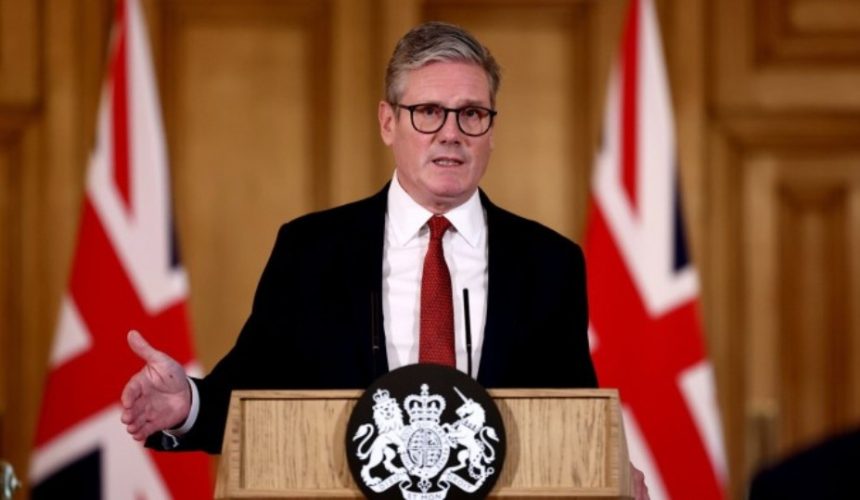
The United Kingdom has committed to a “wide-ranging military contribution” as part of a multinational coalition to safeguard the Strait of Hormuz, a move aimed at stabilizing global energy markets and protecting British economic interests.
The announcement, delivered by the UK’s Ambassador to the United States, Sir Christian Turner, marks a significant escalation in Britain’s maritime security posture.
Working in tandem with France, the UK will lead a defensive mission to ensure the freedom of navigation through the world’s most critical oil chokepoint.
This commitment comes at a delicate time for the Starmer administration, balancing domestic military funding concerns against the urgent need to curb rising inflation and petrol prices at UK pumps, which have seen double-digit increases since the onset of regional hostilities in February 2026.
Why is the UK Sending Military Forces to the Strait of Hormuz?
In a high-stakes virtual summit co-chaired by London and Paris on Friday, 17 April 2026, nearly 50 countries gathered to discuss the deteriorating security situation in the Persian Gulf.
Following months of tension and a period where the Strait of Hormuz was effectively closed to Western-aligned traffic, a fragile ceasefire in Lebanon, brokered by the US on 16 April, has provided a window for diplomatic and military intervention.
Starmer claims Britain will now lead a “defensive” military mission with France to protect shipping in the Strait of Hormuz.
Trump has already forced the strait open and done the hard work.
Now Starmer and Macron want to jump in at the last minute and act like they’re the ones… pic.twitter.com/QSiBwW1DHy
— British Intel (@TheBritishIntel) April 17, 2026
Sir Christian Turner, speaking at an event in Washington, confirmed that the UK’s role would be “significant” and “wide-ranging.”
The mission is designed to “reassure commercial vessels” and prevent the imposition of illegal tolls or restrictions by regional actors.
The initiative is explicitly framed as a defensive and peaceful mission, separate from US offensive operations. The core objectives include:
- Freedom of Navigation: Ensuring UK-flagged tankers and international cargo ships can pass without harassment.
- Mine Clearance: Utilizing the Royal Navy’s world-leading expertise in autonomous mine-hunting technology to clear routes.
- Maritime Reassurance: Providing a persistent naval presence to deter non-state actors and stabilize insurance premiums for shipping companies.
How Does a Crisis 3,500 Miles Away Affect UK Towns and Cities?
While the physical events are unfolding in the narrow waterway between Oman and Iran, the consequences are being felt directly in British households and transport hubs.
Impact on UK Energy Hubs
- Port of Milford Haven, Wales: As the UK’s largest energy port, Milford Haven is the primary entry point for Liquefied Natural Gas (LNG) from the Gulf. Any disruption in Hormuz directly threatens the terminal’s supply chain and the UK’s power grid.
- Fawley Refinery, Southampton: Disruptions to crude oil shipments impact the output of the UK’s largest refinery, leading to immediate supply shocks for petrol stations across the South of England.
- Lloyd’s of London: The maritime insurance market in the City has seen “war risk” premiums skyrocket, which shipping firms pass down to consumers through higher costs for goods.
What are UK Leaders Saying About the “Wide-Ranging” Commitment?
The UK government has been quick to align this military commitment with national economic security. However, the move faces internal and external scrutiny.
Prime Minister Keir Starmer stated, “The world needs the Strait of Hormuz fully open because that is how we keep prices down for our people. This mission is about protecting the British household budget as much as it is about international law.”
The NATO Critique: The mission has drawn sharp criticism from US President Donald Trump, who dismissed the UK-France initiative and labelled NATO a “paper tiger.”
Trump expressed frustration that allies reached out only after he had “stabilised” the situation, claiming they were “useless” when the US initially needed support for its offensive against Iran.
In London, Lord Robertson of Port Ellen (former Nato chief) accused the government of “corrosive complacency,” warning that the UK’s armed forces are “stretched to breaking point” and under-funded for such a significant global commitment.
Will This Mission Lower Petrol Prices at UK Pumps?
For the British public, the Strait of Hormuz is a primary driver of the current Cost of Living Crisis. Since the conflict began on 28 February 2026, the economic data have been stark:
| Economic Metric | Pre-Crisis (Jan 2026) | Current (April 2026) |
| Petrol (Avg. per Litre) | £1.42 | £1.56 (+14p) |
| Diesel (Avg. per Litre) | £1.48 | £1.77 (+29p) |
| CPI Inflation Projection | 2.1% | 3.5% |
| Wholesale Gas Prices | Baseline | +75% |
Octopus Energy and other UK suppliers have warned that while the energy price cap protected consumers through the spring, the “Hormuz spike” could lead to significantly higher bills in the July-September quarter unless the naval mission successfully stabilizes the market.
Is the Strait Actually Open for Business Now?
Iranian Foreign Minister Abbas Araghchi recently declared the strait “completely open” for the duration of the 10-day ceasefire in Lebanon.
However, maritime analysts at Dryad Global and UK intelligence suggest this “opening” comes with strict Iranian-coordinated routes.
The UK-France mission aims to provide an independent security guarantee so that vessels do not have to rely solely on Iranian “permission,” which could be withdrawn at any moment.
What Happens Next?
Military chiefs and strategic planners are set to meet next week at the UK’s Permanent Joint Headquarters (PJHQ) in Northwood. This meeting will determine the specific assets the Royal Navy will deploy.
- Deployment of Type 45 Destroyers: To provide anti-air and anti-ship protection for convoys.
- Autonomous Mine-Hunting: Deployment of the Royal Navy’s new RFA Proteus to ensure the channel remains clear of explosives.
- Diplomatic Friction with Washington: As the UK leads a “European-heavy” mission, tensions with the Trump administration over the future of NATO are expected to intensify.
- Summer Budget Review: Chancellor Rachel Reeves may be forced to announce an emergency uplift in defence spending to sustain a long-term presence in the Gulf.