
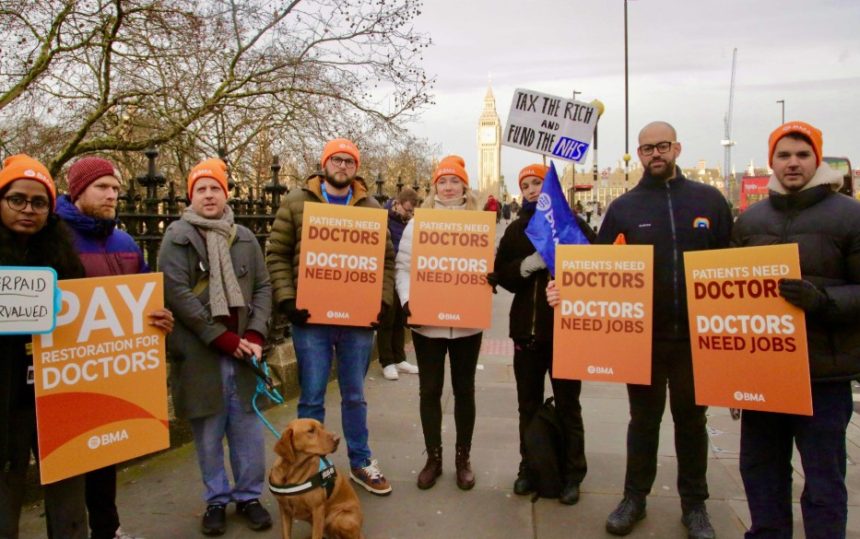
The National Health Service is bracing for what is set to be one of the most disruptive periods in its 78-year history.
Following the breakdown of high-stakes negotiations between the British Medical Association (BMA) and the Department of Health and Social Care, resident doctors across England are preparing for a massive six-day walkout.
The industrial action is scheduled to commence at 7:00 am on Tuesday, 7 April 2026, directly following the Easter Bank Holiday, and will continue until Monday, 13 April.
NHS strike action by Resident Doctors starts from 7am on Tuesday 7 April and runs until 7am on Monday 13 April. Some NHS services will be affected.
You will be contacted if your appointment needs to be changed.
Please continue to come forward for the care you need. pic.twitter.com/DYpbMNLaY8
— Healthwatch Stockton-on-Tees (@HwStockton) April 2, 2026
His escalation follows previous disputes where resident doctors’ strikes disrupted elective care, and the timing is particularly critical as it follows the Easter Bank Holiday weekend, a period when the NHS typically experiences a surge in admissions.
Despite a “final offer” from the Government, which included pay increases and the creation of 1,000 additional speciality training places, the BMA’s resident doctors committee rejected the deal.
Why did the “Crunch Talks” between the BMA and Wes Streeting fail?
The collapse of the latest round of negotiations marks a significant failure in the government’s attempt to stabilise the NHS.
Health Secretary Wes Streeting had presented what he termed a “comprehensive” pay and jobs package.
This offer included an average pay rise of 35.2% over a four-year window when combined with previous increments, alongside a promise of 1,000 new speciality training posts to alleviate the “bottleneck” in career progression.
However, the BMA’s resident doctors committee rejected the proposal on two primary grounds:
- The “Referendum Trap”: The BMA accused the government of insisting on a six-week referendum period. Dr Jack Fletcher argued this was a tactical move to “tie the union’s hands” and expire their current strike mandate without offering a guaranteed resolution.
- Pay Restoration: The union maintains that the offer still falls short of “full pay restoration,” accounting for the real-terms pay cuts experienced by doctors since 2008.
In response to the BMA’s refusal to put the offer to its members, the government took the drastic step of rescinding the 1,000 training places, claiming they are no longer “financially or operationally” viable due to the cost of the impending strike.
We strike NEXT WEEK.
Follow the link in our bio to learn where and when our resident doctors picket lines are happening from 7 April. https://t.co/f6Lpg3LQaj pic.twitter.com/ahsPs8dIa6
— Resident Doctors (@BMAResidents) April 2, 2026
How will the post-Easter walkout affect UK patients and hospitals?
The timing of this strike is strategically chosen to maximise impact, occurring immediately after a four-day bank holiday when hospital admissions typically surge.
- Location of Impact: Every major NHS Trust in England, from the Royal Victoria Infirmary in Newcastle to the Royal Cornwall Hospital in Truro, will be affected. London hubs like St Thomas’ and The Royal London are expected to see the highest volume of procedure cancellations.
- The “Training Workforce” Dilemma: Because resident doctors (formerly known as junior doctors) make up nearly 50% of the medical workforce, their absence forces consultants to step down to cover emergency care. This creates a “domino effect” where elective surgeries, such as hip replacements and cataracts, are cancelled to ensure A&E departments remain safe.
- Reliability Concerns: NHS England leaders have expressed concern that the “unreliability” of the current system is forcing a radical rethink. There is now a push to move toward a “blended clinical family,” utilising more Physician Associates and permanent staff to reduce the system’s dependence on doctors in training.
What are the specific demands the BMA says would stop the strike?
Dr Jack Fletcher has indicated that the BMA is willing to call off the action even as late as the Easter weekend, provided the government meets several “red line” requirements:
- A credible “road map” to pay restoration: Moving beyond one-off percentages to a multi-year commitment.
- Reinstatement of Training Places: The BMA views the withdrawal of the 1,000 posts as an “inflammatory” act of bad faith that must be reversed.
- Reform of the Pay Review Body (DDRB): Ensuring the body that recommends doctor pay is truly independent and not constrained by government-set spending limits.
What is the cost of the strike to the UK taxpayer?
The economic burden of these strikes is becoming a central point of contention. The Department of Health and Social Care estimates that each day of industrial action costs the NHS approximately £50 million in lost activity and additional cover costs.
By the end of these six days, the total cost for 2026’s industrial action could exceed £1.2 billion. This is money that the government argues could have been spent on the very training places and equipment the BMA is campaigning for, creating a circular and increasingly bitter financial argument.
Is Sir Keir Starmer’s 48-hour ultimatum a gamble?
The Prime Minister’s decision to issue a 48-hour “take it or leave it” ultimatum marks a shift in the government’s communication strategy.
By moving from negotiation to confrontation, the Labour government is attempting to signal to the public that they are “on the side of the patient” rather than the unions.
However, political analysts suggest this is a high-stakes gamble. If the strikes result in record-breaking wait times or patient safety incidents, the public blame may shift from the BMA to the government for failing to secure a deal, especially after promising to “fix the NHS” during the election campaign.
What happens next if no deal is reached by Tuesday?
If the picket lines form on Tuesday morning, the NHS enters “crisis mode.“
- The Six-Month Mandate: The BMA currently holds a legal mandate for strike action that lasts for another six months. This means further walkouts could be called throughout the summer.
- Legislative Intervention: There are whispers within Westminster about the potential use of Minimum Service Level (MSL) legislation, which would legally require a certain number of doctors to work during strikes. However, this remains a highly controversial move that could further alienate the medical profession.
- Clinical Model Shift: Expect to see NHS England accelerate plans to upskill non-doctor roles to ensure that the health service is never again paralysed by a single group’s industrial action.