


The start of a new year brings a fresh calendar of celestial moments, and skywatching events in January offer plenty for UK stargazers to enjoy.
From the striking Wolf Moon to a challenging meteor shower and a bright appearance from Jupiter, January 2026 packs several notable astronomical events into just a few weeks.
While some of these moments are brief, others unfold over several nights, making them accessible even to casual observers watching from their gardens or local parks.
What makes January special for skywatching in the UK?
January stands out because multiple events occur close together, particularly in the first half of the month.
The combination of a full moon, Earth’s closest approach to the Sun, and the year’s first major meteor shower all happening around the same date is relatively uncommon.
Key highlights UK observers should note include:
- The Wolf Moon supermoon is peaking on 3 January
- The Quadrantid meteor shower is reaching its maximum on the same day
- Jupiter at opposition on 10 January
These events are visible across most of the UK, weather permitting.
January 2026 skywatching calendar at a glance
| Date (2026) | Event | What UK viewers can expect |
|---|---|---|
| 2–3 January | Wolf Moon (Supermoon) | Larger and brighter full moon visible nationwide |
| 3 January | Earth at perihelion | Earth is closest to the Sun; no weather impact |
| 3 January | Quadrantid meteor shower peak | Reduced visibility due to moonlight |
| 10 January | Jupiter at opposition | Brightest and clearest Jupiter views of the year |
| 18 January | New moon | Darker skies for stargazing and photography |
When can the Wolf Moon be seen, and why is it important?
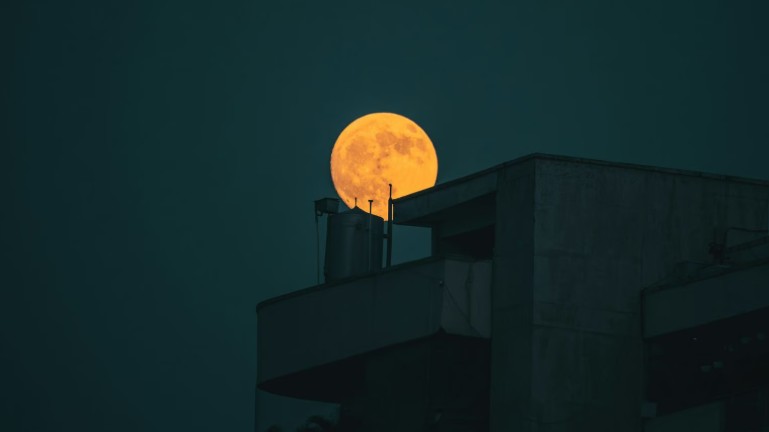
The Wolf Moon, January’s full moon, will rise over the UK on the evening of 2 January 2026, reaching its fullest phase in the early hours of 3 January.
Traditionally named after winter folklore, the Wolf Moon is one of the most recognisable full moons of the year.
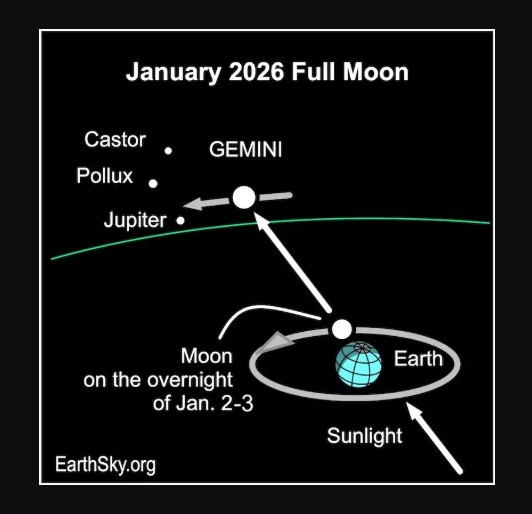
According to EarthSky, the 2026 Wolf Moon will also qualify as a supermoon, meaning it will appear larger and brighter than an average full moon.
“A supermoon occurs when the Moon is near its closest point to Earth, making it noticeably brighter in the night sky,” EarthSky.
For UK viewers, the most impressive sight is often just after moonrise, when the Moon appears low on the horizon and visually enlarged.
Why is Earth’s perihelion happening at the same time?
On 3 January, Earth reaches perihelion, the point in its orbit where it is closest to the Sun. Although this might sound dramatic, it has little effect on UK temperatures.
Important facts to understand:
- Earth is around 147 million kilometres from the Sun at perihelion
- The UK’s winter weather is caused by Earth’s tilt, not distance
- Perihelion happens every year in early January
The coincidence of perihelion and a supermoon makes this date especially interesting for astronomy enthusiasts.
Will the Quadrantid meteor shower be worth watching?
The Quadrantid meteor shower is the first major meteor display of the year and peaks on 3 January 2026. Under ideal dark-sky conditions, it can produce up to 40 meteors per hour, but this year’s bright full moon will make viewing more difficult.
While January’s Quadrants are often affected by strong moonlight, UK skywatchers experienced far better viewing conditions last year during summer displays such as the Perseids, which coincided with the Sturgeon Moon and produced clearer skies and higher meteor counts.
According to The Planetary Society, moonlight significantly reduces the number of visible meteors.
“Bright moonlight washes out fainter streaks, but brighter fireballs can still be seen,” The Planetary Society.
UK observers may still have some luck by facing away from the Moon and watching during the early morning hours before dawn.
Why is Jupiter at opposition a big deal for UK stargazers?
On 10 January 2026, Jupiter reaches opposition, placing Earth directly between the gas giant and the Sun. This alignment makes Jupiter brighter and visible throughout the night.
For UK skywatchers, this means:
- Jupiter will be at its closest point to Earth
- It will appear brighter than at any other time this year
- Even small telescopes can reveal Jupiter’s moons
This is considered one of the best opportunities of the year to observe Jupiter from the UK.
What does the January new moon mean for stargazing?
The new moon on 18 January marks the final major skywatching event of the month. With no moonlight in the sky, darker conditions return, making it easier to spot faint stars and deep-sky objects.
This period is beneficial for:
- Stargazing from rural areas
- Astrophotography
- Observing star clusters and nebulae
After this, attention turns to February’s main attraction, a partial solar eclipse.
A cool guide: Astronomy & Celestial Events in 2026
from r/coolguides on Reddit
What does this mean for the UK public?
January’s night sky provides free, accessible moments of wonder during the darkest weeks of winter.
Whether it’s noticing the bright Wolf Moon on an evening walk or spotting Jupiter glowing above rooftops, these skywatching events in January offer a simple way for people across the UK to reconnect with the natural world.