
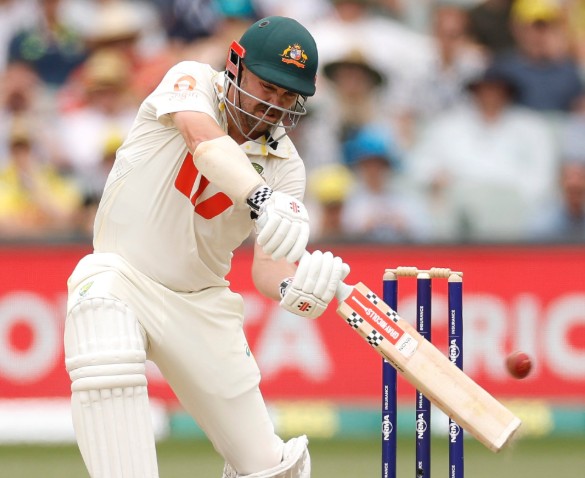
For England supporters watching from home, the Ashes story is becoming uncomfortably familiar.
On Day Three of the Third Test, Travis Head delivered another reminder of Australia’s dominance, producing a calm yet ruthless unbeaten 142 that placed him alongside Sir Don Bradman in the history books.
Head’s innings at Adelaide Oval has not only pushed Australia firmly on top of the match, but also deepened England’s uphill battle to keep the Ashes alive.
Why is Travis Head proving so difficult for England to stop?
Travis Head has quietly become the heartbeat of Australia’s batting line-up in this Ashes test series. While England has rotated bowlers and altered tactics, the left-hander has continued to score runs with control and confidence.
Across the series so far, Head has passed the 350-run mark, making him Australia’s most productive batter. His ability to absorb pressure early before accelerating has exposed England’s lack of penetration on flatter Australian pitches.
Dropped on 99, kissing the deck for 100!
What a rollercoaster for Travis Head #Ashes | #MilestoneMoment | @nrmainsurance pic.twitter.com/p3RtaE5cNE
— cricket.com.au (@cricketcomau) December 19, 2025
Former players analysing the match highlighted how Head’s patience stood out. “England has tried attacking fields, defensive lines, and short bowling. Nothing has unsettled Head when he bats like this.”
What historic Don Bradman record has Travis Head matched?
With his Adelaide century, Head became only the fourth Australian to score four consecutive Test hundreds at the same venue, a rare achievement that links modern cricket with its golden past.
Hometown hero Travis Head unleashed his fourth hundred in as many Tests in Adelaide #WTC27 | #AUSvENG: https://t.co/tPZVCGZI7D pic.twitter.com/D7roFiQPDv
— ICC (@ICC) December 19, 2025
The record places him in elite company. Don Bradman achieved the feat at Melbourne between 1928 and 1932, while Michael Clarke and Steve Smith managed similar runs at Adelaide and Melbourne respectively in the modern era.
Head is now the latest name on that short and prestigious list. Only one batter in Test history has gone beyond this mark, New Zealand’s Kane Williamson, who scored five consecutive hundreds at Hamilton.
How did Head’s Adelaide innings shape the Third Test?
England began the match with encouraging energy, and there were early signs that Australia could be put under pressure.
Jofra Archer, in particular, bowled with pace and movement that briefly unsettled the top order, forcing cautious adjustments and creating moments when wickets looked possible. The changing balance during those opening spells was reflected in the early scorelines.
However, once Head found his timing, that momentum vanished. His calm approach drained England’s intensity, and the bowlers were unable to sustain the pressure they had built.
By stumps, Australia had stretched their first-innings lead to 356 runs, effectively putting the contest beyond England’s reach.
“This was an Ashes-defining innings, not loud, not rushed, just relentless.”
Has Travis Head dominated the entire Ashes series?
Head’s influence began earlier in the series when Australia promoted him to open the batting in Perth. On a lively surface, he struck a rapid century that set the tone for Australia’s eight-wicket victory.
Although he followed that with a few lower scores, his response in Adelaide underlined why Australia persists with him in key roles.
His adaptability, whether opening or batting in the middle order, has become one of Australia’s biggest advantages.
What does this mean for England’s Ashes campaign?
Australia already holds a 2–0 series lead, and another Test win would guarantee Ashes retention. England now find themselves needing a near-perfect run in the remaining matches to avoid defeat.
From a UK perspective, the concern is not just results but patterns. England’s bowling attack has struggled to break partnerships, while Australia’s senior batters continue to punish loose spells, with Travis Head leading the charge.